Children of Vaelinya · Elara · 2 of 8
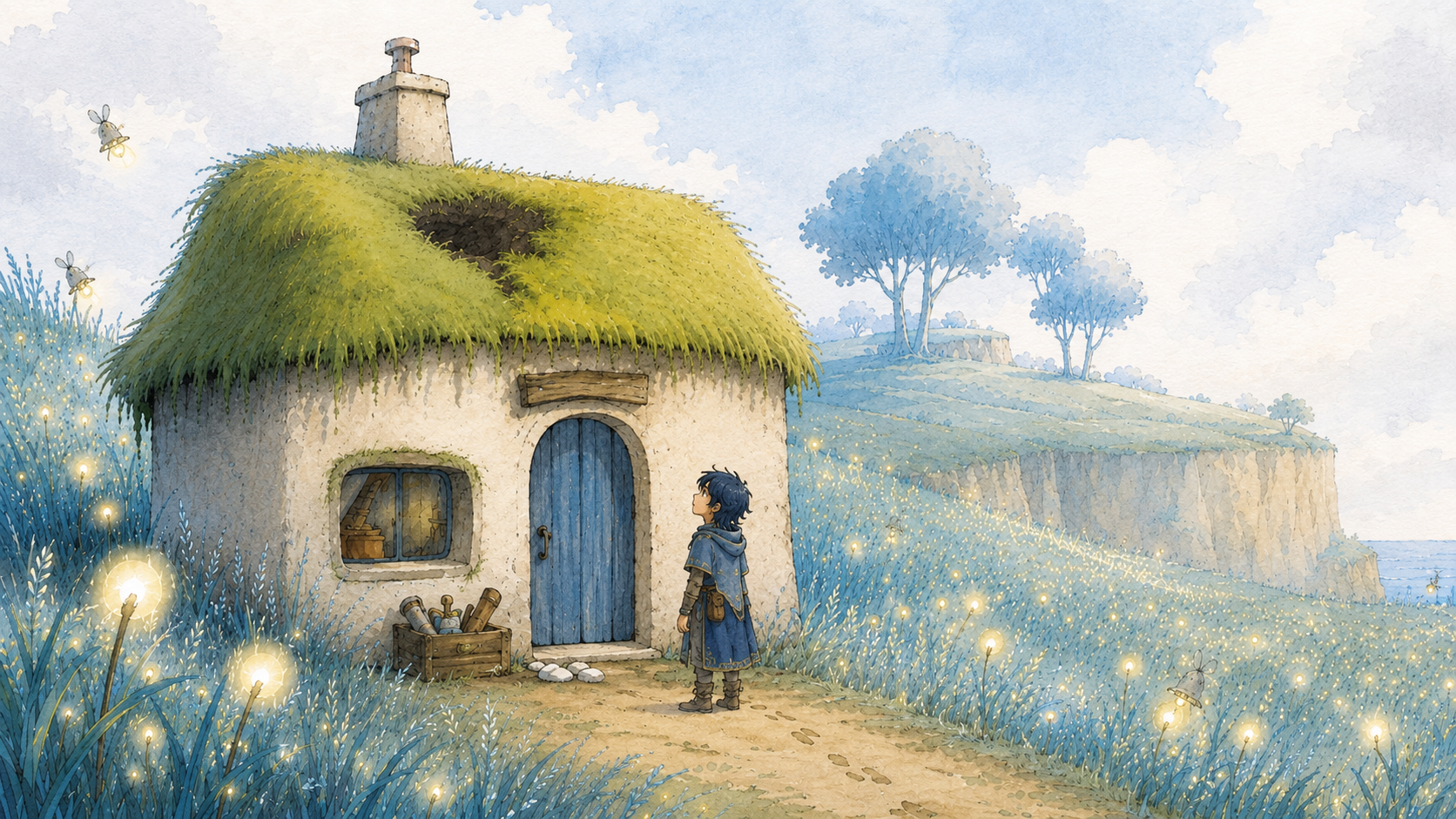
Elara and the Harp with One Rough String
The harp had a voice like a door that would not quite close.
Elara heard it from the passage outside the music room.
One note rang clear.
Another rang clear.
Then came a scrape of sound, thin and rough, followed by silence.
A boy inside said, “Again.”
The same three sounds followed.
Clear.
Clear.
Rough.
Silence.
Elara stood in the doorway.
The old floor-harp rested beside the window. Its wooden frame was dark with years of hands. One side had been repaired near the base, and three strings were newer than the others. A fourth string, pale and slightly frayed, ran crooked across its peg.
Aren sat on the stool with both hands in his lap.
Maer Seli, who kept the instruments, stood beside him with a tuning key.
“We should replace it,” she said.
Aren shook his head.
“It will keep scraping.”
“I know.”
“It may snap.”
“I know.”
Maer Seli’s shoulders lifted and fell.
Elara came in quietly.
Aren looked at her, then away.
The harp had belonged to his older sister before she left Vaelinya for the lower valley. Everyone in the music room knew that much. Elara knew nothing more, and she did not pretend to.
The frayed string was the one his sister had repaired herself after it broke during winter practice.
That fact did not make the string sacred.
It did make replacing it more complicated than replacing a string.
Maer Seli touched the peg. “Aren, I will not cut it without your agreement. But we cannot ask the harp to hold a dangerous string forever.”
Aren stared at the floor.
Elara sat on the edge of the long bench.
Nobody spoke for a while.
Outside, rain ticked against the window ledge.
Aren finally said, “When it scrapes, it sounds wrong.”
Maer Seli nodded.
“And if we change it, it will sound wrong in a different way.”
Elara looked at the harp.
“Can I hear the whole piece?” she asked.
Aren frowned. “It is not a whole piece.”
“What is it?”
“Four bars.”
“Can I hear the four bars?”
Aren glanced at Maer Seli.
She moved away from the harp.
Aren placed his fingers on the strings.
The first phrase was quiet and steady. The second climbed. Then his hand reached the frayed string.
Scrape.
He stopped at once.
Elara waited.
“You always stop there?” she asked.
“Yes.”
“Because the sound hurts?”
Aren’s eyes narrowed.
Elara corrected herself before he had to.
“Because you do not want to continue after it?”
“Yes.”
That answer belonged to him.
She kept it there.
“Can the harp be played without that string?”
Maer Seli said, “Yes. The missing note would have to be avoided or moved.”
Aren shook his head. “Then it is not her part.”
Elara looked at him.
“Do you want it to be her part?”
“I want it not to be gone.”
The room became very still.
Maer Seli sat down on the second stool.
Elara listened to the rain.
There were several things they could do, and none of them would make that sentence untrue.
That mattered.
“What if we do not decide yet?” Elara said.
Maer Seli looked at the string. “We can loosen it enough that it is safe for today.”
Aren’s shoulders dropped a little.
“Then it will sound worse.”
“Probably,” said Maer Seli.
Aren almost smiled.
She turned the peg until the frayed string slackened.
The dangerous tension left it.
Now when Aren plucked it, the note gave a dull unhappy buzz.
He winced.
Elara did not tell him the sound was beautiful.
It was not.
She did not tell him the brokenness made the harp better.
It did not.
Instead she asked, “What happens if you keep playing?”
Aren stared at her.
“I told you. I stop.”
“I know. I am asking what happens if you choose not to.”
He looked suspicious.
“Why?”
“So we know.”
After a moment, he set his hands on the harp again.
The first phrase.
The second.
The loose string buzzed.
His fingers froze.
Then, slowly, he played the next note.
And the next.
The music did not repair itself.
The rough place remained rough behind them.
But the later notes existed too.
Aren played to the end of the four bars.
When the last string settled, he sat with his hands resting on the frame.
Maer Seli said nothing.
Elara said nothing.
Aren swallowed.
“I forgot the last part sounded like that.”
Elara asked, “Like what?”
He searched for the word.
“Open.”
She nodded.
Not happy.
Not healed.
Open was his word.
Maer Seli leaned towards the harp. “There may be another choice.”
Aren looked at her.
“We could keep the old string after we remove it.”
He frowned.
“Keep it where?”
“In the instrument box. Or tie it into the inside of the case. It would no longer carry tension, but it would not be thrown away.”
Aren looked at the frayed cord.
“That feels strange.”
“It is strange,” said Maer Seli.
Elara liked that answer.
People often tried to make difficult choices sound simple after they had chosen them.
The choice did not become simple because it became necessary.
Aren reached out and touched the string near the bottom of the frame.
“Could we hear a new string before we cut this one?”
Maer Seli nodded. “Yes.”
She opened a wooden drawer and brought out three lengths of harp cord.
One was bright and firm.
One was softer.
One was slightly thicker than the old string.
They did not attach them yet. Maer Seli stretched each between two small tuning pegs on a testing board.
Aren plucked the first.
Too sharp, he said.
The second.
Too soft.
The third.
He listened longer.
Elara listened too, but not for the answer inside him. She listened to the actual sound: its warmth, its length, how quickly it settled beside the neighbouring note when Maer Seli played them together.
Aren asked for the third one again.
Then he asked for the old loose string.
Buzz.
Third string.
Clear, low, steady.
Old string.
Buzz.
He rubbed his thumb against the edge of the stool.
“I do not like choosing.”
“No,” Elara said.
“I thought you would help.”
“I am helping.”
“That is annoying.”
“Yes.”
Maer Seli laughed softly.
Aren looked at Elara. “What would you pick?”
“The third string.”
His face changed.
Elara added, “For the harp. I do not know what you should choose about your sister’s string.”
Aren looked back at the instrument.
That difference seemed to matter.
He could ask Elara about sound.
He did not have to hand her the meaning of the sound as well.
After a while, he said, “Take the old one off carefully.”
Maer Seli picked up the tuning key.
“Do you want to stay?”
Aren thought.
“No.”
“Do you want us to wait?”
“Yes.”
So they waited.
Aren went outside and stood under the covered passage while rain moved over the courtyard.
Elara stayed in the room, but she did not follow him with questions.
When he came back, his hair was damp at the edges.
“I want to do it now.”
Maer Seli loosened the peg completely.
The old string came free without snapping.
Aren held it in both hands.
It looked smaller away from the harp.
He wrapped it in a square of blue cloth and placed it in the instrument box himself.
Then Maer Seli fitted the third testing string.
She tuned it slowly.
The harp changed.
There was no point pretending otherwise.
Aren played the four bars again.
The new note was clean.
He stopped after it.
Elara waited.
Aren looked at her.
Then he played on.
The last part opened into the room.
When he finished, he touched the new string once more.
“It does not sound like her,” he said.
Elara nodded.
“No.”
Aren rested his hand against the harp frame.
“It sounds like this harp now.”
The rain softened outside.