Children of Vaelinya · Fina · 3 of 8
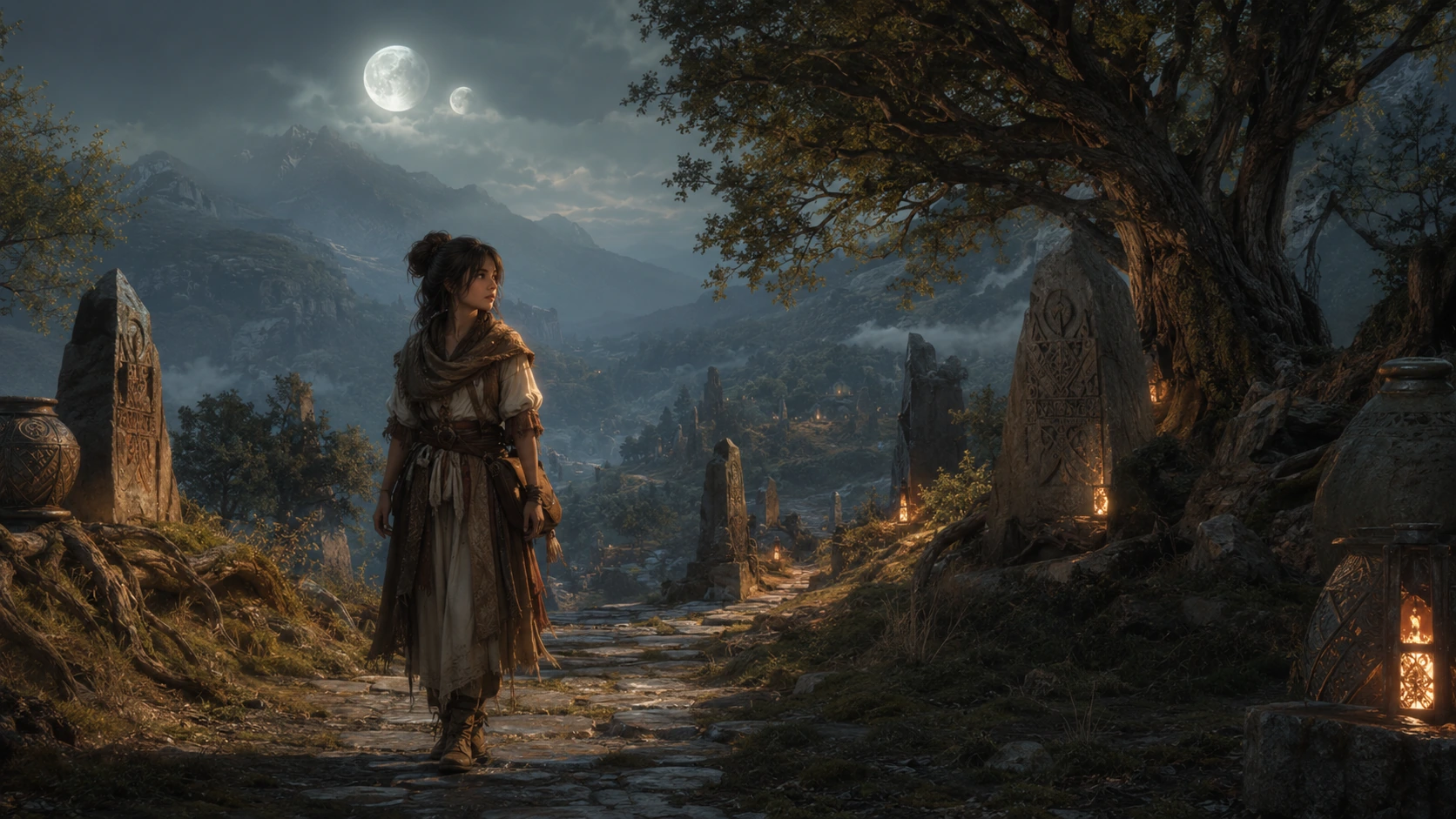
Fina and the Rushing River
The river had moved the stepping stones.
Not far.
Far enough.
Yesterday, six flat stones crossed the narrow side-channel below the growing terraces. Today, after a night of heavy rain upstream, only four showed above the brown water. One had rolled onto its edge. Another had vanished entirely.
Fina stood on the bank with a basket hooked over one arm.
Across the channel, Maer Pell held up both hands.
“Do not jump it.”
Fina looked at the gap.
“I was measuring.”
“With your knees.”
“They are useful measuring tools.”
“Not today.”
The side-channel was not the Great River. It was usually shallow enough for children to wade across with rolled trousers and complaints about cold feet. But the rain had filled it until the current pressed hard against the grass at both banks.
They were supposed to carry bundles of cut reed to the drying rack on Fina’s side.
The direct crossing was gone.
Upstream, the channel narrowed between two stone shoulders, but the water there ran faster. Downstream, it widened into a shallow bend lined with rushes.
Fina pointed downstream.
“We could cross there.”
Maer Pell looked.
“Maybe.”
That was enough for Fina’s feet.
She ran along the bank.
“Fina.”
“I am only looking.”
“You are looking very fast.”
The shallow bend looked easy from above.
Water spread across a broad bed of small stones. Fina could see the bottom. That made it feel ordinary.
She stepped in.
The first step was ankle deep.
The second was halfway to her knee.
The third moved.
Not her foot.
Everything.
The current pushed sideways against her shin. Fina shifted her weight to correct it and put her next foot where the bottom looked pale.
The pale patch was loose gravel.
Her boot slid.
The basket flew off her arm.
Fina sat down very suddenly in cold water.
The current turned her half around and shoved her two body-lengths downstream before her hand closed around a clump of rushes.
She stopped there, wet to the waist, furious and startled.
Maer Pell was already running.
“I am all right!” she shouted.
“Stay where you are.”
That instruction annoyed her because staying where she was had not been her idea.
But she stayed.
Maer Pell came down the bank with a long pole. He kept both feet on dry ground and held one end towards her.
Fina took it.
“Do not pull me straight at you,” she said.
“I was not going to.”
“The water is pushing that way.”
“I noticed.”
He moved downstream instead, keeping the pole angled with the flow. Fina let the water carry part of her weight while she stepped towards the bank.
Three steps later she was out.
Her basket had caught in the rushes farther down.
Fina stared at the channel.
“I could see the bottom.”
“Yes.”
“It looked slow.”
“Yes.”
“It was not.”
“No.”
Maer Pell looked at her soaked clothes.
“Anything hurt?”
Fina checked.
Elbows. Knees. Ankles. Pride.
“No.”
“Good. Then we have learned cheaply.”
Fina disliked the word cheaply while water ran out of her sleeves.
They collected the basket and went back to the others.
Nobody laughed.
That was almost worse.
Rian handed Fina a dry wrap from the supply cart.
“You went sideways,” he said.
“The river went sideways.”
“You were in the river.”
“That made it a shared decision.”
Maer Pell gave her a look.
Fina wrapped herself in the cloth.
Across the channel, the reed bundles still waited.
“We still need them over here,” Rian said.
Maer Pell nodded. “But nobody steps in that water again.”
Fina looked downstream at the bend where she had fallen.
She did not want to wait for the water to drop.
She also did not want to prove anything to it.
Those were different feelings.
“What if the reeds cross without us?” she asked.
Rian frowned. “They have not learned to walk.”
“They float.”
Maer Pell followed her gaze.
The cut reeds had already been tied into narrow bundles. They were light enough to carry under one arm.
Fina pointed to the upstream bank.
“If we put one in the water there, where does it come out?”
“Downstream,” said Rian.
“Yes, thank you.”
“Glad to help.”
Fina ignored him.
“The current does not go straight across. So do not make it.”
Maer Pell crouched and picked up a small fallen twig.
“Test first.”
They walked upstream to a point opposite the start of the broad bend.
Maer Pell dropped the twig near the far bank.
It shot forward, curved towards the centre, then drifted diagonally across as the channel widened.
Fina ran beside it on dry land.
The twig reached their bank nearly twenty paces downstream.
She stopped beside it.
“Again.”
They tried a thicker stick.
Same curve, slightly slower.
Then a short scrap of reed tied with cord.
It crossed too, but caught in the rushes before reaching the bank.
Fina pulled it free.
“So the rushes are the problem.”
“Or the catcher,” said Maer Pell.
Fina looked at them again.
The rushes had stopped her basket.
They had also stopped her.
“What if we want things to end there?”
They moved a rope downstream and stretched it loosely between two people on Fina’s bank, not across the current but along the edge of the rush bed. It was not a barrier strong enough to stop a person. It did not need to be. It only needed to guide floating reeds into the shallow margin.
On the far bank, Rian tied a spare cord around one reed bundle.
“Ready?”
Fina crouched at the downstream catch point.
“Send it.”
Rian placed the bundle in the water.
It leapt away from him.
Fina ran.
Not because the river was racing her.
Because the landing point was moving relative to where the bundle had started.
The bundle turned with the widening current, spun once, then reached the rush bed. Its loose cord snagged on a stem.
Fina stopped beside it.
“Bad cord.”
They shortened the tail.
Second bundle.
This one crossed cleanly and touched the guide rope. Fina drew it into the shallows with a hooked pole.
Third bundle.
The current had strengthened slightly. It travelled farther before crossing.
Fina shifted ten paces downstream before it arrived.
Rian shouted, “You moved the finish!”
“The river moved it first!”
That became the work.
Not waiting for one perfect moment.
Not forcing one fixed route.
Watching what each bundle did and moving the catch point when the water changed.
A larger bundle rode lower and needed to start farther upstream.
A small one spun too easily, so they tied it tighter.
When a branch came down the channel, they stopped sending bundles until it passed.
When the water rose against one marker stone, Maer Pell moved everyone farther from the edge.
Fina did not argue.
She had already been shown what the current could do with an assumption.
By midday, the last reed bundle reached the drying side.
Fina and Rian carried them up the bank.
Her clothes were nearly dry.
Her boots were not.
Rian looked back at the channel.
“So you learned patience.”
Fina made a face.
“No.”
“You did not jump back in.”
“That is not the same thing.”
“What did you learn?”
Fina watched a leaf enter the narrow water, accelerate, then swing wide in the bend.
“That moving does not mean choosing the same direction every second.”
Rian considered this.
“That sounds suspiciously like patience.”
“It is steering.”
Maer Pell, carrying the last bundle behind them, said, “You may both stop naming the lesson.”
Fina grinned.
The river kept moving.
So did they.