Children of Vaelinya · Nira · 2 of 8
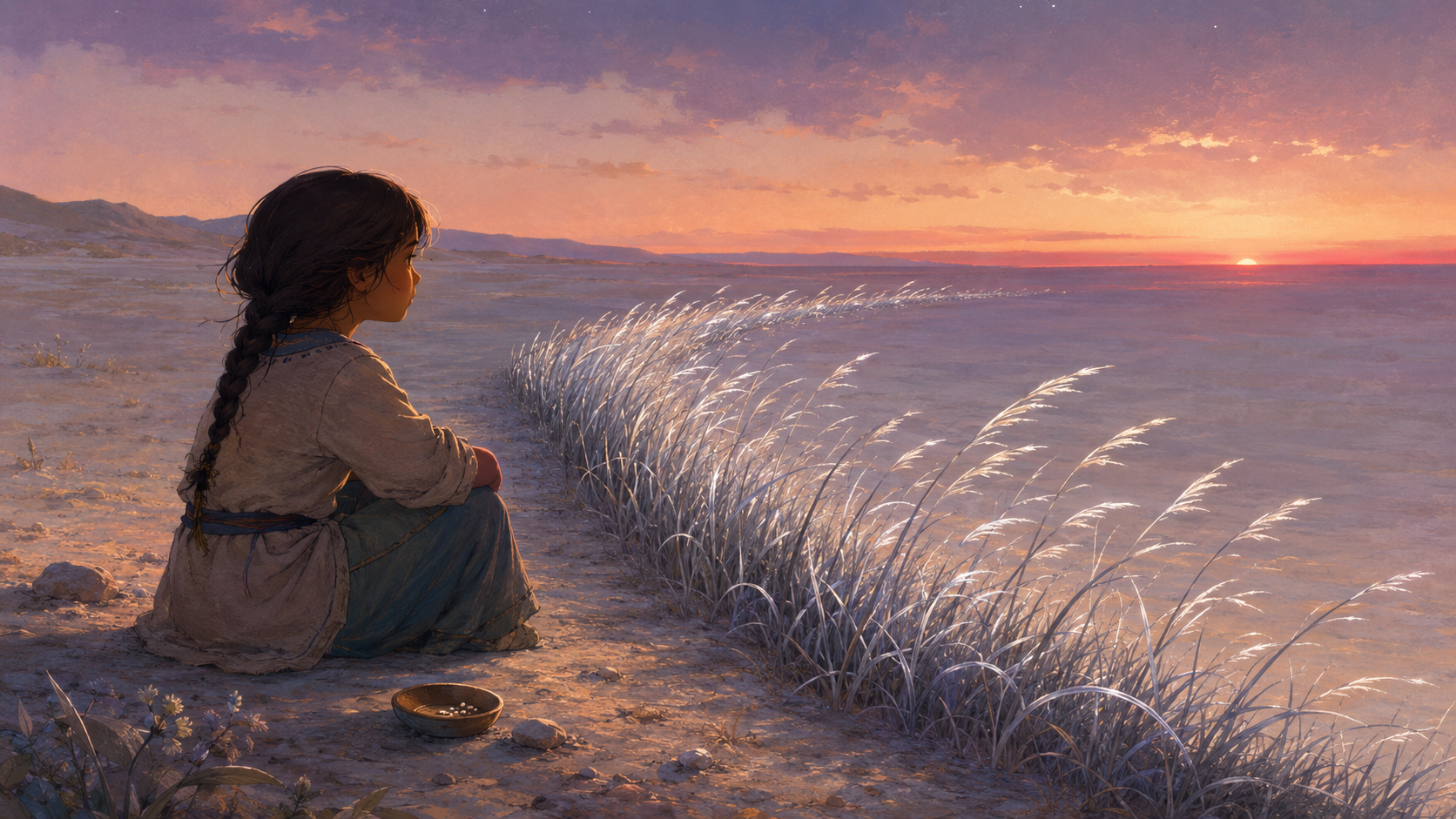
Nira and the Path After Rain
By morning, the rain had washed the path away.
Not the stones.
Not the hill.
Not the thorn bushes that leaned over the lower slope.
Only the part people trusted.
Yesterday there had been a clear brown track from the sheep meadow to the north storehouse. Boots had pressed it flat for years. Cart wheels had cut two shallow lines through the soil. Children could follow it while talking and barely look down.
Now the hillside was one wide sheet of wet earth.
Nira stood at the gate and narrowed her eyes.
“Do you see it?” asked Teren.
“No.”
He looked surprised.
Nira glanced at him. “You asked if I see the path.”
“I thought you would.”
“I see the hill.”
“That is less useful.”
“It is more honest.”
The north storehouse roof showed between the trees above them. They needed to reach it before noon because one of the grain shutters had come loose in the night. The storm had passed, but another bank of grey cloud was building beyond the western ridge.
Teren pointed uphill. “It was there.”
“Probably.”
“You walked it yesterday.”
“Yes.”
“So did I.”
Nira crouched beside the gatepost.
The earth there was churned by many feet. Rainwater had filled the deepest marks and softened the edges until bootprints, hoofprints and wheel ruts had become one brown confusion.
She did not look for a perfect footprint.
Perfect things disappeared first in weather.
She looked for what the rain had failed to erase.
A crushed stem lay angled uphill.
Three pebbles had been pushed into the mud beside it.
A strip of pale clay showed through the darker topsoil.
Nira touched the clay.
“Cart wheel?” Teren asked.
“Maybe.”
“Maybe again.”
“Yes.”
She stood and followed the pale strip for six steps.
Then it vanished.
Teren made a sound through his nose.
Nira looked left.
The ground dipped towards a drainage hollow.
Right led towards a line of hazel roots.
Straight ahead, the slope steepened.
Yesterday’s path had bent somewhere here.
She remembered that.
Memory was evidence.
It was not the same as proof.
Nira walked to the hazel roots.
Mud had splashed the lower bark on one side.
She crouched again.
“Something passed close here,” she said.
“Us?”
“Something.”
Teren looked at the grey sky. “Can we decide it was us?”
“No.”
“We are going to be old before we reach the storehouse.”
Nira smiled a little. “Then we will be very experienced when we arrive.”
A third child, Yara, came through the gate carrying a coil of shutter cord over one shoulder.
“Why are you still here?”
Teren pointed at Nira. “She is refusing to know things.”
Nira pointed at the hillside. “The path is gone.”
Yara looked once. “Go straight.”
Nira looked at the slope.
“Why?”
“The storehouse is straight.”
“The hill is not.”
Yara sighed.
They tried straight anyway.
Nira agreed because a route could be tested faster than argued about.
For the first twenty steps, it worked.
Then Yara’s boot sank to the ankle.
She stopped.
Teren stopped behind her.
Nira stepped sideways onto firmer ground.
The wet patch stretched ahead in a darker band.
“Old runoff,” Nira said.
Yara pulled her boot free with a wet sucking noise.
“Not straight.”
“Not here,” Nira corrected.
They moved back downslope.
Now Nira had one more piece of evidence: the old path probably avoided the runoff band.
She followed its lower edge.
Near a flat stone she found half a print.
Only the heel remained. The front had dissolved into rainwash.
Teren leaned over her shoulder. “Finally.”
“Whose?”
He stared.
Nira pointed.
The heel mark was narrow and deeply cut on one side.
Yara lifted her boot.
Her heel had the same worn corner.
“You made it yesterday?” Nira asked.
Yara looked at the print.
“I came down after supper.”
“Which way?”
Yara pointed uphill and slightly left.
Teren brightened. “So there is the path.”
Nira looked left.
There were no more prints.
“Maybe.”
Teren groaned.
But they followed.
A few steps later, Nira found a second trace: a fern bent away from the slope, not downhill as rain would have pushed it, but sideways.
Then a third: a small wedge of clean stone where mud had been scraped off recently.
Then nothing.
They stopped below a cluster of blackthorn.
Two routes opened around it.
The upper route was shorter.
The lower route curved away from the storehouse.
Yara said, “Upper.”
Teren said, “Lower. I remember the bend.”
Nira remembered a bend too.
But she could not remember which side of the thorn it took.
She walked to the upper route.
The soil was smooth.
Too smooth.
She scraped it lightly with the side of her boot.
Under the top mud lay a thin layer of loose leaves.
No compressed earth.
She walked to the lower route.
At first it looked worse. Water had crossed it in several narrow streams.
Then she saw three stones in a line.
Not placed.
Pressed.
Their uphill edges were muddy. Their downhill faces were clean.
“Feet step on the tops,” she said. “Water cleans the lower faces.”
Teren crouched beside her.
“So people used this side.”
“Probably.”
He opened his mouth.
Nira pointed to a hazel twig lying across the route.
Its underside was pale and dry where it had rested on the ground before the rain. The top was dark and wet.
One end had been snapped recently.
“Someone stepped on that after it fell,” she said.
Yara nodded. “Lower.”
This time they all agreed.
The route curved away from the storehouse for almost thirty steps.
Teren kept glancing uphill.
“This feels wrong.”
“It might be,” Nira said.
“You say that when we are already walking it?”
“Yes.”
“What would make you change your mind?”
“Evidence.”
He muttered something about evidence having excellent timing.
Then the ground levelled.
Ahead stood an old ash tree with one low branch cut flat years ago.
Yara laughed.
“I remember that.”
“So do I,” said Teren.
Nira did too.
The old path passed the ash before turning uphill.
But memory alone had not told them how to reach it safely after the rain.
They crossed beneath the tree.
Beyond it, the path began to return in pieces.
A wheel rut filled with clear water.
A square bootprint under an overhanging root.
A patch of flattened moss on a stepping stone.
Each trace lasted only a little way, but the traces agreed often enough to form a direction.
Near the top of the slope, they found where the old path had failed completely.
A section of bank had slipped during the storm. Mud and stones covered the track from wall to ditch.
Teren stared at it.
“So the footprints lead into that.”
Nira nodded.
“We cannot follow them.”
“No.”
“Then they were useless?”
Nira looked at the slide.
The path had brought them exactly far enough to discover where it was no longer a path.
“That is useful.”
Yara pointed across the ditch. “There is dry ground above the wall.”
Nira studied it.
No route showed there.
This time, nobody asked her to find a hidden one.
They tested the ground together.
Yara used the shutter pole to check the ditch edge.
Teren found two stable stones.
Nira watched for fresh cracks in the wet bank.
They crossed one at a time and climbed the last slope on grass.
The storehouse reached them before noon.
One shutter hung open, knocking softly against the wall.
Yara tied it back while Teren checked the grain sacks.
Nira stood under the eaves and looked down the hill.
From above, she could almost see the old route.
Almost.
A pale scrape near the gate.
A curve around the runoff.
The blackthorn bend.
The ash tree.
The slide.
Not one perfect line.
A chain of small things that had agreed, disagreed, disappeared and been checked.
Teren came to stand beside her.
“So you did find the path.”
Nira shook her head.
“We found where it had been.”
He considered that.
“And then?”
“We found where it stopped being useful.”
Below them, rain began again in a fine grey curtain.
The last clear heelprint disappeared.