Children of Vaelinya · Nira · 8 of 8
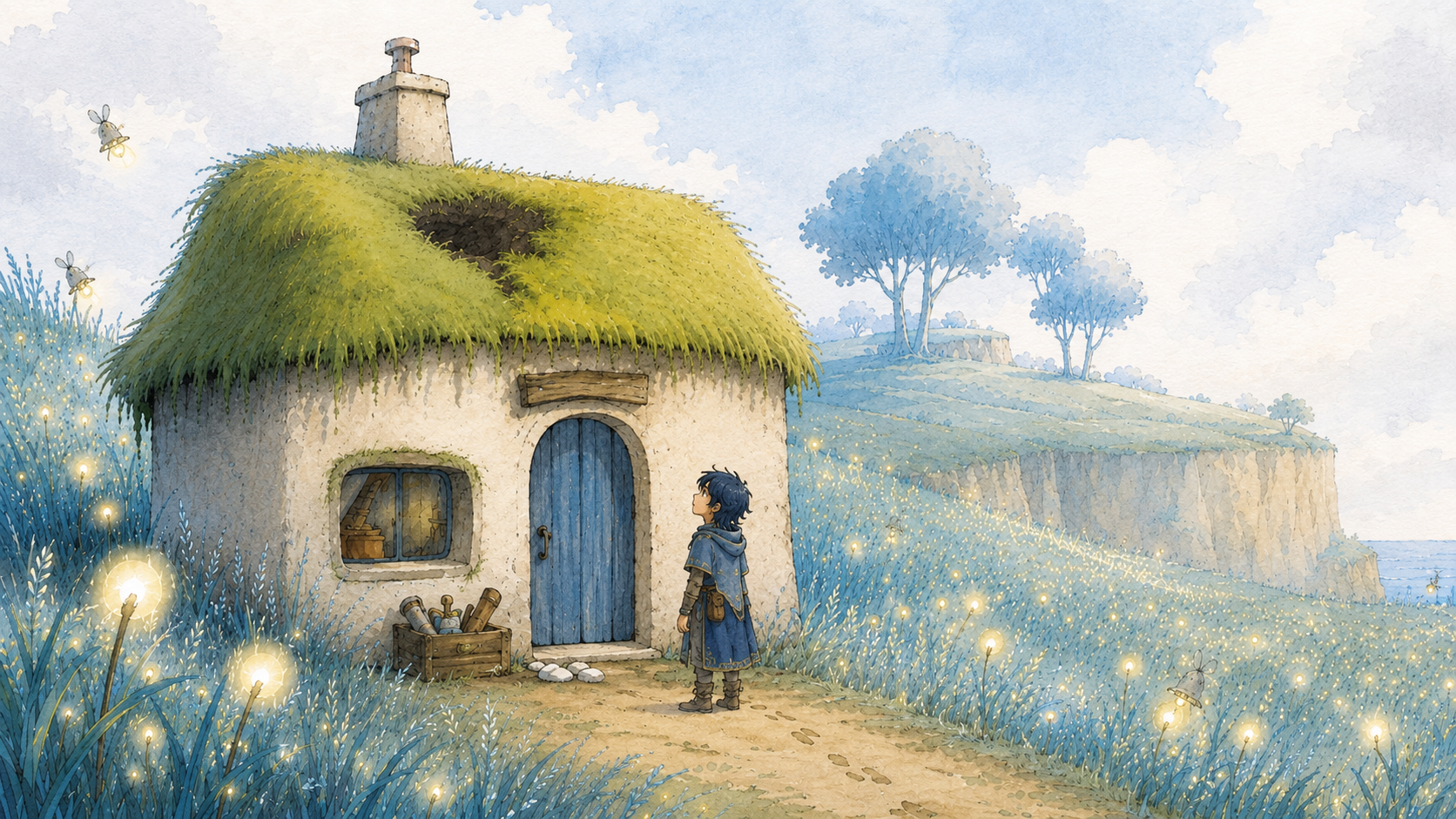
Nira and the Night Bearings
The stars did not point at the missing survey marker.
Nira checked that first.
The old field notebook lay open on a stone table beside the daytime map. Its paper had gone soft at the corners, and the ink changed colour from page to page where different hands had added notes.
Three entries mattered.
One described a bright star above the mill roof.
Another recorded two stars aligned with the north ridge.
A third gave an angle measured from the orchard wall.
Maer Soven leaned over the notebook.
“Useful?”
“Maybe.”
“That is not an answer.”
“It is the answer I have.”
Soven smiled.
They were trying to locate an old boundary marker that had vanished from the current survey map. Nobody knew whether the stone had been moved, buried, broken or simply missed when the newer map was copied.
The notebook was older than either of them.
Nira read the first observation again.
“Bright star over the east edge of the mill roof.”
Soven looked toward the mill.
It was daylight.
“No star.”
“The roof is still there.”
“Good.”
They walked to the mill and stood where the old observer might have stood.
Might.
That word followed them everywhere.
The notebook did not give an exact standing place. It described a fence corner that no longer existed and a trough that had been replaced years ago.
Nira chose a point beside the surviving wall.
“If they stood here, the line would run north-west.”
Soven handed her a string.
They stretched it across the map.
The line crossed the ridge near an old footpath.
Nira marked it lightly in charcoal.
“One.”
The second observation was harder.
The two stars had been recorded as almost vertical above a notch in the north ridge.
The notch still existed, but the notebook gave no exact distance from it.
Nira drew another line.
It crossed the first near rough ground west of the old storehouse.
“There,” she said.
Soven did not answer.
Nira looked at him.
“You are supposed to say whether that makes sense.”
“I am waiting to see whether you believe two lines make a stone.”
Nira looked back at the intersection.
She wanted them to.
Two lines crossing looked decisive.
Then she opened the notebook to the third observation.
The orchard bearing did not cross at the same place.
It passed several paces south.
“Bad map?” Soven asked.
“Maybe.”
“Bad old measurement?”
“Maybe.”
“Bad new line?”
Nira frowned.
“Also maybe.”
Soven folded his arms.
“That is a large pile of maybe.”
Nira stared at the three lines.
If she erased the third, the answer became neat again.
She did not erase it.
Instead she drew a rough oval around the area where all three measurements could plausibly fit.
“Not a point.”
“Better.”
They took the map to the survey team.
Maer Halen, who led the team, listened while Nira explained the notebook.
When Nira finished, Halen said, “Show me where the old observer stood.”
“I cannot.”
“Then why is this line here?”
“Because if they stood near the surviving mill wall, the first observation fits.”
“If.”
Nira nodded.
Halen tapped the map.
“Good. Keep saying it.”
The next morning they went to the rough ground.
The grass was waist-high in places. Old stones pushed through the soil, and the foundations of a demolished shed made almost every pale corner look like it might be a marker.
Nira carried the map.
Soven carried the notebook.
The surveyors carried poles, measuring cord and a spade.
At the first intersection, they found nothing.
Nira checked twice.
The ground was hard and stony.
One surveyor pushed a probe into the soil.
No buried block.
Nira looked at the map.
“This was my first answer.”
Halen said, “It was your first intersection.”
The correction irritated her because it was accurate.
They moved south.
A flat stone appeared beneath grass.
Nira’s heart jumped.
The surveyor cleared it.
It was part of the old shed foundation.
“Another almost-answer,” Soven said.
“Do not name them.”
He laughed.
They kept going.
Near the southern edge of Nira’s oval, the ground dipped toward a drainage channel.
One surveyor called them over.
A squared corner of stone showed beneath a mat of roots.
They cleared it carefully.
The block was narrow, weathered and set deeper than the surrounding foundation stones.
Halen measured from two modern reference points.
Then she compared the numbers with an older boundary description from a separate ledger.
“It could be the marker.”
Nira waited.
Soven looked at her.
“You did not say ‘is.’”
“I am learning.”
Halen smiled.
They exposed one side of the stone.
A shallow cut mark appeared.
The same mark was described in the ledger.
“That improves the case,” Halen said.
“Enough?”
“Enough to record it as the recovered marker, with the evidence attached.”
Nira looked back toward the first intersection, hidden by grass.
The stone was not where the neatest crossing had put it.
It was inside the wider uncertain area created by keeping the third observation.
That mattered more than being right on the first try.
Back in the workroom, Nira redrew the map.
This time she did not erase the failed intersection.
She marked it as first reconstruction — not confirmed on ground.
Beside the recovered stone she wrote:
location supported by field recovery, cut mark and independent ledger description.
Soven read it.
“No stars?”
“They are in the source notes.”
“Why not write ‘the stars led us here’?”
Nira gave him a look.
“They did not.”
“They helped.”
“Old observations of them helped.”
“Less poetic.”
“More true.”
Soven nodded as if that was the answer he had wanted.
Later, a younger child came to see the map.
“Can you use stars to find anything?”
Nira thought about the question.
“No.”
The child looked disappointed.
Then Nira added, “You can use stable things to compare where you are, if you know enough about the observation and keep track of what you do not know.”
The child looked even less impressed.
Soven laughed from the next table.
Nira ignored him.
That evening, she carried the old notebook outside.
The sky was clear.
She found the bright star above the mill roof.
For a moment, standing in the dark, the alignment felt almost magical.
The same light had been seen by someone years before.
Nira understood why people wanted to turn patterns like that into messages.
It was satisfying.
It was also unnecessary.
The star did not know about the marker.
The marker did not know about the star.
A person had measured one from the other.
Another person had written it down.
Years later, Nira had tested the record against the ground.
And when the ground disagreed with her first clean answer, the ground had won.
She closed the notebook.
Above the mill, the bright star remained exactly where it appeared to be.
It pointed nowhere.
That was what made it useful.