Children of Vaelinya · All Eight Together · 7 of 8
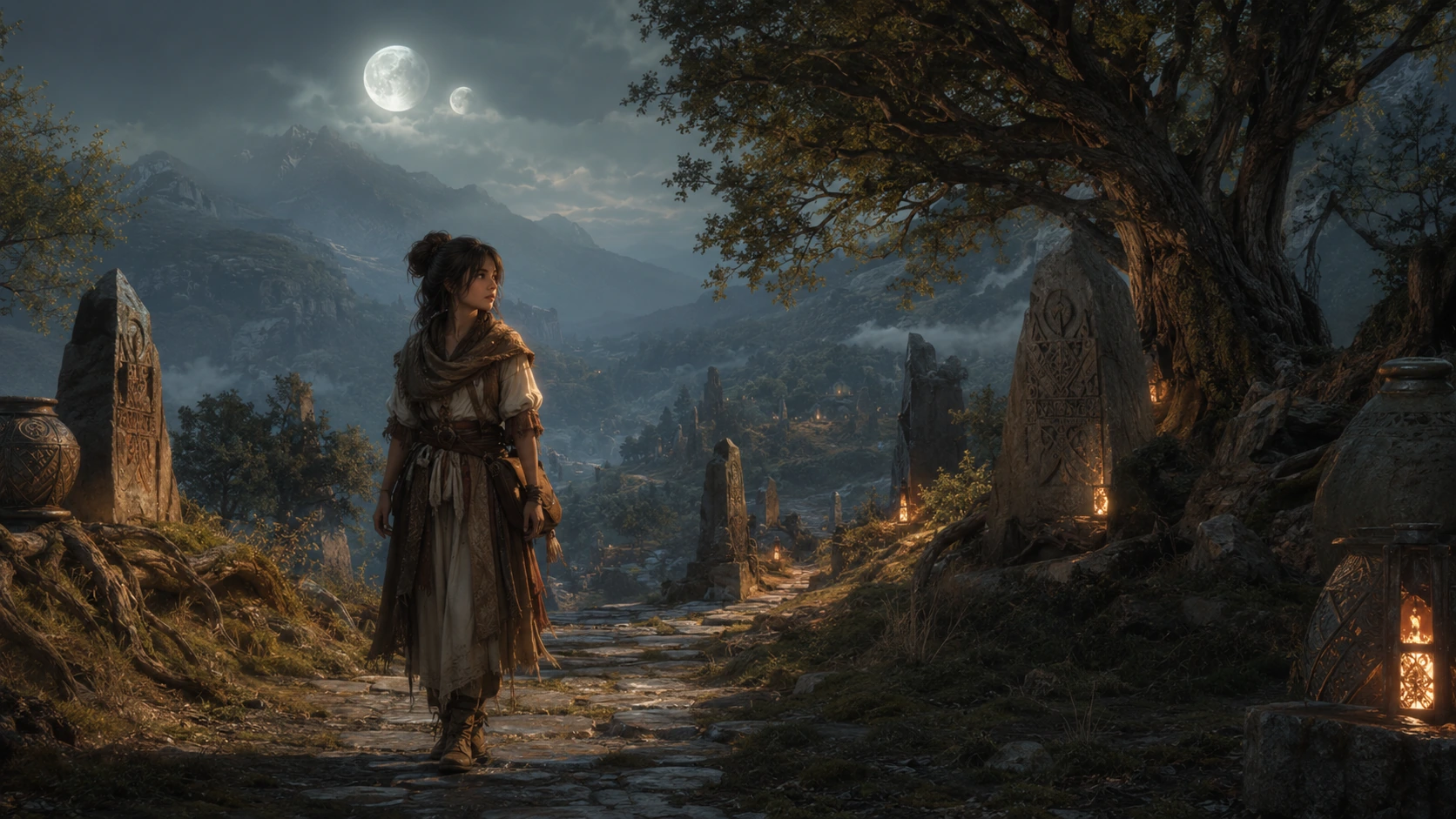
The Garden of Turning Paths
The teaching garden had four entrances and no route that stayed best for long.
On dry days, visitors could cross the central grass.
After rain, gardeners closed it.
During harvest, handcarts used the wide east path.
When school groups worked beside the quiet western beds, through-traffic went elsewhere.
None of that made the garden confusing until someone tried to draw one map that would always be right.
The eight children were helping deliver seven light seed trays to seven teaching tables before an afternoon session.
At the first gate, three arrows pointed in three different directions.
Fina looked at the list.
“Table one first. Shortest route is across the grass.”
She lifted the first tray.
Nira looked at the grass.
“Closed.”
A small wooden marker stood half hidden beneath wet leaves.
KEEP OFF — SOFT GROUND
Fina changed direction.
“East path.”
Reo pointed toward a narrow gap behind the bean frames.
“That is shorter.”
Kaelen took the empty shared carrier and tried the turn.
The carrier caught between two posts.
“It fits a person,” he said. “It does not fit this.”
Reo looked at the tray in Fina’s hands.
“Then the route is not wrong. It is wrong for the carrier.”
Fina carried the first tray through the narrow path by hand.
They reached table one.
It was empty.
A gardener looked up from tying peas.
“That class moved to table four this morning.”
Fina stared at the tray.
“We delivered it perfectly to the wrong place.”
Valen crossed out TABLE 1 on the list.
“Do we know where the other classes are?”
Lina went to the garden office and asked.
She returned with a changed destination sheet.
Two classes had moved because one included a visitor who needed the wider surfaced route.
Another table had stayed near the western beds because the group preferred a quieter edge.
A fourth class would not arrive until later.
“The destination list is not current,” Lina said.
Valen rewrote it before anyone efficiently delivered the remaining trays to yesterday’s arrangement.
Now they had seven trays, seven destinations and several different kinds of route.
Fina said, “We can split up.”
Elara looked at the shared carrier.
“If everybody chooses their own fastest path, who knows where the carrier is when someone else needs it?”
Kaelen rested one hand on the handle.
“And some trays are easy to carry alone. Two are not.”
They needed coordination without making everyone use one route.
Liana walked to the western bench.
It stood under a trellis beside the quieter teaching beds.
“Use this as one return point if you need it,” she said, “but do not make every route come through here.”
Fina frowned.
“Why not? It is central enough.”
“Then it stops being quiet.”
Reo pointed to a broad paved junction near the tool shed.
“Main carrier return there. Western bench only for the routes already using the west side.”
Kaelen tested where the carrier could be parked without blocking turns.
Valen marked both return points.
The first round of deliveries began.
Fina carried a small tray through the bean-frame path.
Reo took another by a route that looked longer on the map but avoided the wet grass and came out directly beside table five.
Kaelen moved the shared carrier along the wide east path with the two heavier trays.
Nira walked ahead checking temporary surface markers.
Lina confirmed the table locations with teachers as they arrived.
Valen marked each delivery complete only after the receiving teacher confirmed the tray.
Elara watched the east lane for harvest-cart movement.
Liana kept the western return point available without turning it into headquarters.
For twenty minutes, the system worked.
Then the harvest crew arrived early.
A handcart loaded with squash filled the east lane.
Elara stopped Kaelen before he entered it with the shared carrier.
“Two large things, one narrow turn.”
Fina looked at the route map.
“Wait?”
Reo looked at the heavy tray.
“Or change the load.”
Kaelen shook his head.
“This one should stay level. Carrying it by hand over the narrow path risks tipping.”
Lina asked the teacher whether the tray had to arrive immediately.
“No. We start with soil samples.”
So they waited.
The tray did not become more important because it was the one currently blocked.
When the harvest cart cleared, Kaelen moved it safely.
At the next junction, Nira found a new marker.
The gardener had opened the central grass again after checking the ground.
Fina smiled.
“Shortcut.”
Nira looked closer.
The marker said:
OPEN TO FOOT TRAFFIC — NO CARTS
Fina looked at the carrier.
“Not our shortcut.”
Reo said, “Still a route for the empty return.”
They used it later when the carrier was not needed.
The same path changed value without changing shape.
Halfway through the deliveries, Lina returned from table six.
“New change.”
Everyone groaned.
“The class at table six moved to the covered teaching bay because the wind is taking their papers.”
Valen updated the destination.
Fina was already halfway there with the wrong route in mind.
She turned back.
“Do I have to return to the start every time something changes?”
“No,” Valen said. “You only have to know which current state you are acting on.”
He handed her the updated slip.
Reo found a side route to the covered bay.
It was excellent for a person carrying one tray.
Then a school group entered from the opposite direction.
The path filled with children.
Elara said, “Route remains possible. Timing does not.”
Fina waited at a wider junction until the group passed.
No route choice solved timing permanently.
At the western edge, Liana found three people waiting beside the bench because someone had started calling it the return station.
She looked at the small chalk arrow Valen had added.
“Who changed this?”
Valen raised a hand.
“I thought it would help people know where the carrier might be.”
“It helps by turning this into traffic.”
He erased the arrow immediately.
They moved the western return point ten paces to a sheltered paved square that did not consume the bench.
The quiet place remained usable.
The route system changed.
That correction mattered again later when one teacher brought a child outside who needed somewhere away from the busy paths.
The bench was still there.
Not because Liana had claimed it for herself.
Because the group had resisted making every useful space serve circulation.
The fifth delivery produced a different failure.
Valen’s list said TRAY 5 — DELIVERED.
The teacher at table five said it had not arrived.
Fina said, “I watched Reo take it there.”
Reo shook his head.
“I took it to the table. Nobody was there, so I left it on the side shelf.”
Lina looked at the teacher.
“Was the side shelf part of the agreed delivery?”
“No.”
Valen crossed out DELIVERED.
“Placed is not received.”
They found the tray safe on the shelf and completed the handover.
The record now distinguished:
IN TRANSIT
PLACED
RECEIVED
Fina groaned.
“We are building a language for moving seven trays.”
“Because ‘done’ turned out to mean three things,” Valen said.
The sixth tray needed the shared carrier.
Kaelen brought it from the main return point.
At a fork, Reo proposed the central grass because the carrier was now empty on the return leg.
Nira checked the marker again.
Still foot traffic only.
“The carrier is empty, but it is still a cart.”
Reo nodded.
“Good catch.”
They took the surfaced path.
By then, the group had stopped asking, “Which is the best path?”
The question was too vague to be useful.
Instead they asked:
Best for which tray?
To which current destination?
Carried how?
At what time?
What route is open now?
What else is using it?
Which spaces should not become corridors?
What counts as delivered?
The seventh tray should have been easy.
It was small.
The destination was close.
The route was open.
Fina lifted it.
Then Lina returned from the teacher.
“They do not need it yet.”
Fina stopped.
“Why not?”
“Their class is finishing something else. They asked for it in twenty minutes.”
Fina stared at the tray.
Every physical fact said go.
The person receiving it said not yet.
“Fine.”
They placed it at the main return point.
Kaelen chose a stable spot out of the walking line.
Valen marked WAITING FOR RECEIVER.
Liana noticed the area was becoming crowded with empty carriers and moved one aside.
Elara watched two school groups approach the junction from different directions and held the tray movement another minute.
Then the teacher waved from the table.
Fina looked around.
Nira confirmed the route marker remained open.
Reo confirmed the hand-carry shortcut still worked.
Kaelen confirmed no carrier was needed.
Lina confirmed the destination and receiver.
Valen changed the state to READY.
Elara checked the crossing flow.
Liana confirmed the path would not spill into the western quiet area.
Fina laughed.
“Now?”
Seven people nodded.
“Now.”
She carried the tray.
They thought the delivery work was finished.
Then the first class sent back two empty trays and asked for a fresh soil sample from the opposite side of the garden.
Fina looked at the seven completed lines on Valen’s sheet.
“That is not part of the plan.”
“No,” Lina said. “It is part of the session.”
The return request tested whether they had built a system or merely survived one list.
The central grass was now open to foot traffic. Reo proposed using it for one empty tray, but Nira found a class kneeling beside the grass edge making observations; the route was technically open and practically disruptive. Elara redirected the return until the class moved on.
The new soil sample needed a shallow carrier because the container could spill. Kaelen found the shared carrier, checked the tray support and rejected the bean-frame shortcut. Valen reopened the state list with a new section rather than changing a completed delivery into an unfinished one. Lina confirmed exactly which teaching table wanted the sample and when. Liana kept the new waiting point away from the western bench even as more people moved through the garden.
Fina started the collection only when the route, carrier and receiver state were current.
Halfway there, a gardener closed one section for watering.
Nobody groaned this time.
Nira read the new marker.
Reo chose the alternate surfaced path.
Elara checked the harvest lane.
Kaelen turned the carrier safely.
Valen changed the state.
Lina sent word to the receiving class that the sample would be later.
Liana kept the detour from consuming the quiet bed route.
Fina moved when the new conditions were ready.
The sample arrived.
That second cycle mattered because it had not been designed in advance. The group could respond without inventing one permanent path or starting the whole garden plan again from zero.
At the end of the afternoon, all seven original trays had reached the people who needed them, and the unplanned return had worked too.
They had used five different routes.
They had abandoned two plans.
One destination had changed twice.
One route had worked for people but not the carrier.
One route had been physically open but badly timed.
One return point had been moved because it damaged a quiet space.
One tray had reached the correct place without yet being properly delivered.
The garden had not revealed a true path.
The children had not taken turns applying eight magical traits.
Often two or three kinds of information mattered at once, and sometimes one child had nothing useful to add until conditions changed.
That was how the work actually felt.
At the gate, Fina looked at the three arrows again.
“Shortest,” she read.
“Wide,” said Kaelen.
“Quiet,” said Liana.
“None of them says true,” Reo said.
Nira checked the wet-grass marker one last time.
Valen folded the final state sheet.
Lina waved to the teachers.
Elara waited for a handcart to pass before they crossed the exit.
Fina smiled.
The right path had never been one path.
It had been the path that was workable for this person, this load, this destination and this moment—and the willingness to choose again when any of those things changed.