A metamorphic Vaelinyan fable
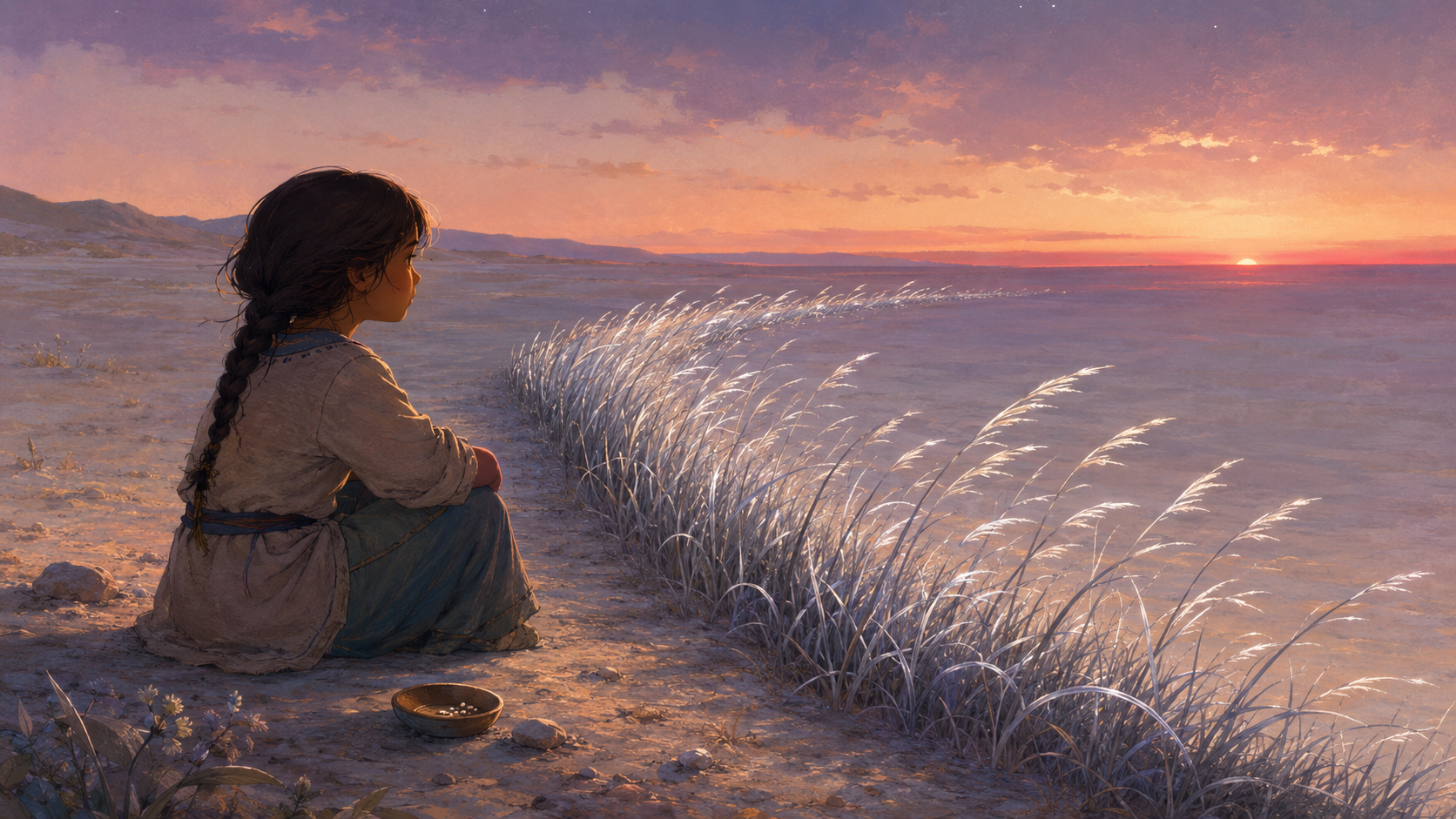
Luma and the Grass That Held Sen's Place
When Sen crosses to Earth, Luma plants a white seed so sadness has somewhere kind to rest.
On the far side of Vaelinya, where the dry wind moved softly over the pale hills, there lived a child named Luma.
Luma had a kind elder friend called Sen.
Sen was old enough to remember six crossings and three returns. Luma was not old enough to remember even one. But that did not matter.
Sen knew where the small blue beetles slept during the heat of the day.
Sen knew how to hear rain before it formed.
Sen knew the names of stones that looked ordinary until evening.
Every dusk, Luma and Sen walked to the edge of the silver plain.
Every dusk, Sen pointed to the low red line where the sun was leaving.
Every dusk, Luma asked the same question.
“Is Earth there?”
And every dusk, Sen gave the same answer.
“Not where we can see it. But yes.”
Then came the half-year turning, when Earth and Vaelinya came near in the old hidden way.
The elders gathered with quiet faces.
The crossing cloths were unfolded.
The listening bowls were filled.
The old songs were sung without hurry.
Sen was going to Earth.
He had been called by a memory he had left there long ago, and Vaelinyans do not hold someone back from a true return.
Luma stood beside him while the crossing circle was made.
She did not cry at first.
Sen knelt and pressed one small white seed into her hand.
“This is not to stop you missing me,” he said. “Missing someone is not wrong.”
“What is it for?” asked Luma.
“So you have somewhere kind to go, when missing me feels too heavy.”
Luma closed her fingers around the seed.
Then Sen crossed.
There was no thunder.
No tearing of the sky.
No great crack in the world.
There was only a stillness, and then a space where he had been.
After that, Luma went to the edge of the silver plain every dusk.
Every dusk, she stood where Sen had stood.
Every dusk, she looked at the low red line.
Every dusk, she asked, “Is Earth there?”
But no one answered in Sen’s voice.
The others tried to help.
Her mother brought warm root-bread.
Her brother brought polished stones.
The old mapmaker showed her where Earth would be, if eyes could see through sunlight and distance and time.
Luma thanked them all.
Still, the space Sen had left stayed there.
It was there when Luma saw the blue beetles and had no one to tell.
It was there when the rain-smell came early and no one smiled in Sen’s way.
It was there at dusk, beside her, where Sen should have been standing.
The space was not empty because Luma had forgotten him.
It hurt because she remembered him.
One dusk, Luma did not go home.
She sat at the edge of the silver plain with Sen’s white seed in her hand.
The dry wind moved over her knees.
The pale hills held their breath.
“I miss Sen,” she said.
The listening bowls in the village began to tremble.
Her mother heard them first.
Then the elders.
Then the children, who were always better at noticing small changes.
They came to the edge of the silver plain, but they did not crowd her.
They made a wide circle.
No one said, “Come away.”
No one said, “Be brave.”
No one said, “It is time to be finished.”
The eldest listener knelt at the edge of the circle.
“Luma,” she said, “the sadness of missing Sen is too heavy to carry only inside you.”
Luma looked down at the seed.
“What should I do?”
“Plant it,” said the eldest listener. “Not to forget Sen. Not to stop loving him. Plant it so you have a place to go when the sadness feels too heavy.”
“Will it take me away?”
“No,” said the eldest listener. “You will stay Luma.”
“Will it make me forget?”
“No.”
“Will it hurt Sen?”
“No.”
“Will it bring him back?”
The eldest listener was quiet for a moment.
“No,” she said gently. “It will not bring him back.”
Luma nodded, because this was the answer she had feared, and also the answer she trusted.
“What will it do?”
“It may give you a place to remember him.”
Luma pressed the seed into the dry ground.
“I miss Sen,” she said again.
The seed opened.
A thin blade of silver grass rose from the dust.
Then another.
Then another.
The grass did not take Sen’s place.
It did not pretend he was back.
It did not tell Luma to stop being sad.
It simply grew in the place where Luma came when she missed him.
The silver grass grew in a crescent, all the blades leaning toward the hidden Earth.
Luma watched it.
The sadness did not vanish.
But now Luma had somewhere to sit with it.
The next dusk, Luma returned to the plain.
The silver grass was waiting.
She sat beside it and told Sen what the blue beetles had done that morning.
The next dusk, she returned again.
The silver grass bent toward the hidden Earth.
Luma told it that her brother had dropped three bowls and blamed the wind.
The next dusk, she returned again.
The silver grass shivered though the air was still.
Luma laughed for the first time since the crossing.
After that, people began to visit the silver grass when someone they loved had gone beyond sight.
They did not pull it.
They did not cut it.
They did not braid it into crowns.
They sat beside it.
Some spoke aloud.
Some said nothing.
Some brought seeds.
Some brought names.
Some only placed one hand on the dry ground and let the world know they were still carrying love.
Each half-year, when Earth and Vaelinya came near in the old hidden way, the silver grass bent lower.
Not sadly.
Not desperately.
Only faithfully, as if greeting something far away.
Luma grew older.
She learned the names of stones.
She learned how to hear rain before it formed.
She learned where the small blue beetles slept during the heat of the day.
Children began to walk beside her at dusk.
They asked where Earth was.
Luma pointed to the low red line where the sun was leaving.
“Not where we can see it,” she said.
“But yes.”
And the silver grass moved softly in the windless light.