Story record 004 · Published
The Mountain Healers Who Would Not Help Their Own
Mera works in a mountain care house that promises nobody will carry pain alone. When she needs help herself, the overseers record her requests but leave the harm in place.
Recognise first
The record through its senses
- Sight
- Ash-grey coats, blue-grey promise stone and damaged terraces hidden behind woven screens.
- Sound
- Bells cutting across bells and strained tone-stones driving birds from the roofs.
- Touch
- Cold hands, steep stone paths and small bitter leaves where strong plants once grew.
- After-feeling
- Care is measured, praised and promised, while the person asking for it is left carrying the harm.
1. Mera’s Work
The Mountain Healing Order lived in a fold between seven mountains. The paths were steep, and clouds sometimes came down to rest upon the roofs.
People travelled there from across Vaelinya. They came with painful feet, old injuries, twisted joints and bodies that no longer moved as they once had.
Above the care-house entrance, words had been carved into a long piece of blue-grey stone:
NO PAIN SHALL BE CARRIED ALONE.
At the first bell each morning, the healers and gardeners gathered beneath those words. They touched their fingertips to the stone and repeated the promise together.
The overseers stood in front. Each wore the same ash-grey coat, fastened high at the throat. Each wore their hair drawn back into the same low knot. Their faces were different, but their clothes, posture and practised expressions made them look almost copied.
Mera had believed the promise for most of her life.
She was a movement healer. She watched how a person placed one foot before the other. She noticed how a shoulder dipped, how a knee turned and how the small bones beneath the heel accepted the ground.
Other healers saw a person walking.
Mera saw the whole conversation between the body and the earth.
She noticed when one sandal wore thin half a finger-width sooner than the other. She heard when a walking staff struck stone with the wrong note. She could place two fingers beneath an ankle and find where pain had begun hiding three years earlier.
Her thoughts moved quickly. One detail called to another until a pattern stood before her like a path marked with lanterns.
Sometimes too many details called at once. Then Mera needed stillness, clear words and time to arrange them. Given those things, she did work that people remembered for the rest of their long lives.
On quiet evenings, Mera collected broad leaves that had fallen beside the stream. She drew tiny paths, houses and unfamiliar animals upon them with dark berry ink.
The drawings had no purpose. Nobody counted them or judged them. Mera made them because making them pleased her.
The overseers praised Mera’s skill when visitors were listening.
Overseer Darel said it most often. She had a long face and a small crease between her eyebrows. From a distance, the grey coat and low knot made her resemble the other overseers.
Darel had once worked at a treatment table. She still noticed an uneven step or a painful turn of the wrist. Now she noticed them while walking towards meetings about numbers.
The Mountain Healing Order had begun with six healers sharing a stone house, a garden and a warm pool fed by the mountain. If a healer became tired, another took their place. If the garden grew poorly, everybody stopped to find out why.
The Order was old, and the mountain paths were difficult. The communities below had allowed it to manage the mountain pocket without much outside help or inspection.
The care house grew. Then it grew again.
More people climbed the mountain for treatment. New rooms were cut into the rock. Records were kept. Waiting lists were counted. The six healers became sixty-four. Above them sat overseers who no longer treated feet, dressed wounds or walked beside frightened patients.
The overseers measured the Order instead.
They measured how many people entered, how many left and how quickly each treatment room became free. They measured the supports made in a day and the names removed from the waiting wall.
They did not measure how many healers went home unable to speak.
The same thinking spread into the growing terraces.
The mountain pocket had once been full of healing plants. Silver-vein leaf grew beneath dark rocks. Sun-cups opened on the eastern slopes. Soft blue moss held water for the dry weeks. Every plant grew where light, stone, water and root allowed it to grow.
The overseers disliked the untidy arrangement.
They ordered the gardeners to place every plant in straight rows. Shade plants were moved into sunlight because the sunny terrace was easier to inspect. Water was diverted towards plants needed for the next season’s targets. Tired soil was planted again without rest.
When the gardeners warned that the roots were weakening, the overseers thanked them for raising the concern.
They wrote the concern in a ledger.
Then they ordered another harvest.
Silver-vein leaves became small and bitter. Sun-cups opened too early and dropped their petals before noon. Fruit formed on the mountain vines, remained hard, then fell to the ground.
Before visitors arrived, workers placed baskets of healthy plants beside the main door. Woven screens were put across the paths to the worst terraces.
The reports sent down the mountain spoke of successful harvests.
2. The Promised Help
Inside the care house, Mera’s days became louder.
There had once been one low bell to mark the beginning of work and another to mark its end. Now there were bells for new patients, delayed patients, urgent work, changed rooms, overseer announcements and unfinished records.
Some bells rang before the previous bell had faded.
Bright tone-stones were fixed above every treatment table so the overseers could see that the rooms were in use. Their white light flickered against Mera’s eyes until it hurt.
When she asked for the stone above her table to be dimmed, she was told that all rooms must appear equal.
The instructions were worse.
One overseer told Mera to give every patient as much time as they needed. A second told her that no appointment should run late. A third reminded her that every record must be completed before the next person entered.
One morning, Mera was fitting a support for an elderly grower named Sovan. His right foot had begun turning inward after an old hillside fall. If the support pressed a little too high, it would move the pain into his knee.
Sovan had climbed most of the mountain with his young neighbour Lina. She had stopped at the lower gardens to examine a patch of grey healing moss while he continued to the care house.
Mera had almost found the correct curve when the urgent-work bell rang.
An overseer opened the door without waiting.
“You must move to the lower room,” she said. “A travelling musician needs this table.”
“I need six more minutes,” said Mera. “If I stop now, I will have to begin the fitting again.”
“We must all be flexible.”
The door closed.
Sovan looked at Mera. “I can wait.”
Mera looked at the half-shaped support in her hands. She could feel the curve leaving her memory as the bells continued.
“You should not have to,” she said.
She worked faster.
That evening, she found a pressure mark on Sovan’s foot and remade the support after everyone else had gone home.
The next morning, an overseer asked why she had used more material than the daily allowance.
Mera decided that she must explain the problem clearly.
She wrote down what she needed:
- one overseer to set her priorities;
- written instructions when plans changed;
- protected time to complete delicate fittings;
- a dimmer tone-stone above her table;
- access to the quiet room between patients;
- notice before meetings whenever possible.
None of these changes required another building. None required another healer. Most required only that the overseers stop interrupting one another.
Three overseers met with her beneath a carving of two hands holding a bowl. They wore identical grey coats. Their hair was drawn into identical knots. Only their faces showed that three different people sat before her.
They listened with grave expressions.
“Your wellbeing matters to the Order,” said Darel.
“We are grateful for your honesty,” said the second overseer.
“You must tell us whenever you are struggling,” said the third.
Mera left the meeting carrying a small warmth of hope.
The tone-stone above her table was just as bright the following morning.
Two overseers gave her different priorities before breakfast. The quiet room had been filled with boxes of unused record tablets. A new bell had been added to remind healers about the other bells.
Mera explained again.
This time, the overseers asked her to record every occasion on which the conditions caused difficulty. She began keeping a second ledger beside her patient records.
When a bell broke her concentration, she recorded it.
When two instructions contradicted each other, she recorded them.
When she could not enter the quiet room, she recorded the boxes blocking its door.
The overseers asked her to suggest solutions. She copied the solutions she had already given them.
They arranged another meeting to discuss the first meeting. Then they held a meeting to check whether the second meeting had properly understood the first.
Each meeting took time away from her patients. The missed work remained waiting when she returned.
The overseers praised Mera for working with them.
Nothing changed.
3. Mera Becomes Ill
At first, Mera believed she had failed to explain herself. She made her words shorter. Then she made them more detailed. She drew a plan of the treatment room. She marked the painful light, the noisy corridor and the route to the quiet room.
One overseer admired the neatness of the plan.
It was placed in a folder.
Weeks passed.
Mera stopped recovering at night.
She lay beneath her woven blanket with her hands repeating the movements of shaping and binding. Bells continued inside her head after the mountain had become silent.
Food lost its order. She could be hungry and unable to choose between bread and fruit. Sometimes she stood in her kitchen holding an empty bowl because she could not remember what came next.
Words became difficult. At work she still spoke gently to patients, but every sentence used strength she no longer possessed. By evening, even a friend’s question could feel like another bell.
Fallen leaves gathered beside Mera’s door. The berry ink dried in its little stone pot. She could no longer reach the quiet part of herself that had drawn paths across the leaves.
Her neighbour Neris began leaving covered dishes beside the door.
Mera returned the dishes clean but could not always remember to say thank you.
One evening, Neris found her standing at the kitchen table with an empty bowl in her hands.
“You keep telling me that you are failing the Order,” Neris said. “But everything you describe is something the care house is doing to you.”
Mera wanted to believe her. The old teaching of the Order was already waiting in her mind.
A TRUE HEALER CONTINUES, HOWEVER MUCH IT COSTS THEM.
Those words had once meant that healers did not abandon people during storms, accidents or dangerous journeys.
The overseers used them differently.
They used them when there were too few healers because several had already become ill. They used them when rest periods were shortened. They used them whenever somebody asked whether the work itself had become harmful.
Mera cared about her patients.
The overseers placed that care around her like a harness and pulled. They used her concern for her patients to make her accept more work.
At the final meeting, Mera said, “I cannot continue like this.”
Her voice came out very quietly.
The overseers leaned forward. Their different faces settled into the same practised expression of concern.
“Your wellbeing is our greatest concern,” said Darel.
“The changes will begin immediately,” she added.
Before Mera reached the door, the third overseer called after her.
“There are six additional patients tomorrow. You will need to shorten each fitting.”
Mera turned around.
No words came.
The next morning, she climbed the stone path to the care house.
Cloud lay across the mountain pocket. Water dripped from the carved letters above the entrance.
NO PAIN SHALL BE CARRIED ALONE.
The first bell rang.
Then the second.
Mera’s hands became cold. Her sight narrowed around the doorway. She told her right foot to move, but it remained on the path. She tried the left. It would not move either.
The door stood open.
Her body would not take her through it.
Another healer found Mera and walked her home.
She did not return the next day, or the day after that.
Mera had not failed to care for people. She had been injured by a place that refused to care for her.
The overseers sent a message written on soft paper. It said that everyone in the Order was deeply concerned and wished her a swift recovery.
They told the communities below that Mera had suffered an unfortunate illness. Their report listed six meetings and several promised changes as though the help had already been given.
It did not say that none of the promised changes had been made.
It did not say that the bright stone still burned above Mera’s empty table.
It did not say that the quiet room was still full of boxes.
The care house continued without her.
So did the mountain, but poorly.
Water channels thinned. Healing moss turned grey at the edges. The tone-stones developed a strained interval that made the mountain birds leave the roofs and settle elsewhere.
The overseers ordered the gardeners to replace the dead plants before the next inspection.
That inspection came sooner than they expected.
4. Lina Checks the Records
Lina travelled back to the Mountain Healing Order with Sovan. His foot still needed care after the old hillside fall. Lina had not forgotten the patch of grey moss she had seen on their earlier journey. She expected the upper terraces to be bright with healing flowers.
At the entrance, she found six baskets overflowing with healthy silver-vein leaf.
Beyond them, the earth was bare.
“Why are all the healthy plants in baskets?” Lina asked.
The welcoming healer glanced towards an overseer. “They grow especially well there.”
Lina looked up at the mountain slope, then back at the shaded doorway.
“Do they?” she said.
While Sovan received treatment, Lina walked through the care house.
She heard bells cutting across bells. She saw healers carrying half-finished work from one room to another. She found a door marked QUIET RECOVERY, opened it and found a wall of boxes.
Behind the care house, woven screens blocked three mountain paths.
Lina moved one screen aside.
The terraces beyond it were full of small dead stalks arranged in perfect rows.
A gardener was digging them out.
“What happened?” Lina asked.
“We planted what we were told to plant.”
“Did you tell the overseers it would not grow here?”
The gardener gave a tired laugh. “Oh, yes. They thanked us beautifully.”
The strained sound of the care house followed Lina to the record chamber.
Darel stepped across the doorway.
“Visitors are not allowed to read the Order’s records,” she said.
Beside the door, another promise had been carved into the stone:
ALL WORK MAY BE SEEN. ALL CARE MAY BE QUESTIONED.
Lina pointed to it. “Then why did the Order put those words here?”
Darel did not move.
Inside the chamber, an elderly record keeper pushed open a narrow side door.
“She has asked about our work, not our patients,” he said. “The promise applies.”
Darel looked at him. For a moment, she appeared ready to close the door again.
Then the bells rang for an overseer meeting. Darel left without answering either of them.
In the workers’ promise ledger, Lina found Mera’s name. Careful marks showed that support had been offered, meetings completed and changes agreed.
Lina asked to see the dimmed treatment stone.
It had not been dimmed.
She asked to see the quiet room.
It was still full of boxes.
She asked who had been appointed to give Mera clear instructions.
Three overseers answered at once.
Lina placed the promise ledger on the table between them.
“You have shown me where you wrote down the help,” she said. “Where did you give it?”
The overseers began explaining their intentions.
Lina waited.
When they finished, they still had not answered her question.
She copied the workers’ records. She spoke with healers, gardeners and patients. She drew the empty terraces and marked the diverted water channels. Then she carried the evidence down the mountain.
The people who returned with her were not overseers from another building.
They were growers who understood tired soil and healers who still treated patients. Stone-tenders came too, along with people who had once depended upon the Order’s care.
They did not begin by calling Mera to another meeting.
With Mera’s permission, they read what she had already written.
They examined the changes she had requested and the rooms where those changes had not been made. They listened to the workers. They followed the dry channels. They touched the bitter leaves and heard the strained tone-stones.
The records, the workers and the damaged land all showed the same pattern.
The Order had treated people and land as things that could be pressed harder without changing shape. When injury appeared, the overseers had recorded it, praised its honesty and continued pressing.
The overseers offered an apology. They proposed a new listening group and promised to write better reports. They still expected to keep the same authority.
The visiting healers and growers refused.
“Another place to record harm will not stop the harm,” one grower said.
The Mountain Healing Order lost its right to manage the mountain pocket without outside inspection.
The overseers who had hidden harm were removed from authority. An apology did not restore their positions.
5. The Care House Changes
Healers and gardeners gained a direct voice in every decision affecting their work. Treatment times were based on what safe care required. When urgent work was added, other work had to be removed. Rest periods became part of the working day. The people working beneath the tone-stones could adjust their light.
The quiet room was emptied.
It remained quiet.
The terraces changed too. Straight rows were broken open. Shade plants returned to shade. Water followed the shape of the mountain rather than the shape of a report. Some exhausted ground was left bare for an entire turning of the seasons.
For a while, it looked as though nothing was being done there.
Rest can look empty to people who have forgotten what it is for.
Mera was not asked to help with the repair.
She was not asked when she would return.
Her recovery did not move in a straight line. On some mornings, she walked to the stream and sat beside it until noon. On others, making breakfast used everything she had.
Nobody rang a bell to mark her progress.
Nobody placed a date upon it.
Slowly, ordinary sounds became ordinary again. Rain on the roof stopped resembling hurried footsteps. A knock at the door became Neris with soup rather than another demand.
One afternoon, Mera mixed fresh berry ink. She drew a winding path across a fallen leaf.
The path did not lead anywhere useful.
It did not need to.
6. Mera Returns
Many months later, Mera chose to visit the mountain pocket.
She stopped twice on the climb. Both times, she rested until her body said it was ready.
At the care-house entrance, the carved promise remained:
NO PAIN SHALL BE CARRIED ALONE.
The words were the same. The care house was different.
Only one bell sounded. The tone-stones held gentle light. Written priorities stood where every healer could see them. Through the open door of the quiet room, Mera saw two chairs, a low lamp and nothing else.
Darel was working in the lower garden under supervision. Her grey coat had been replaced by a gardener’s brown tunic. Her hair had come loose around her face.
When she saw Mera, she put down her basket.
“We listened,” she said.
Mera looked at the care house, the open water channels and the workers deciding together how much could safely be done that day.
“You heard me before,” she said. “This time, someone changed something.”
She continued along the path.
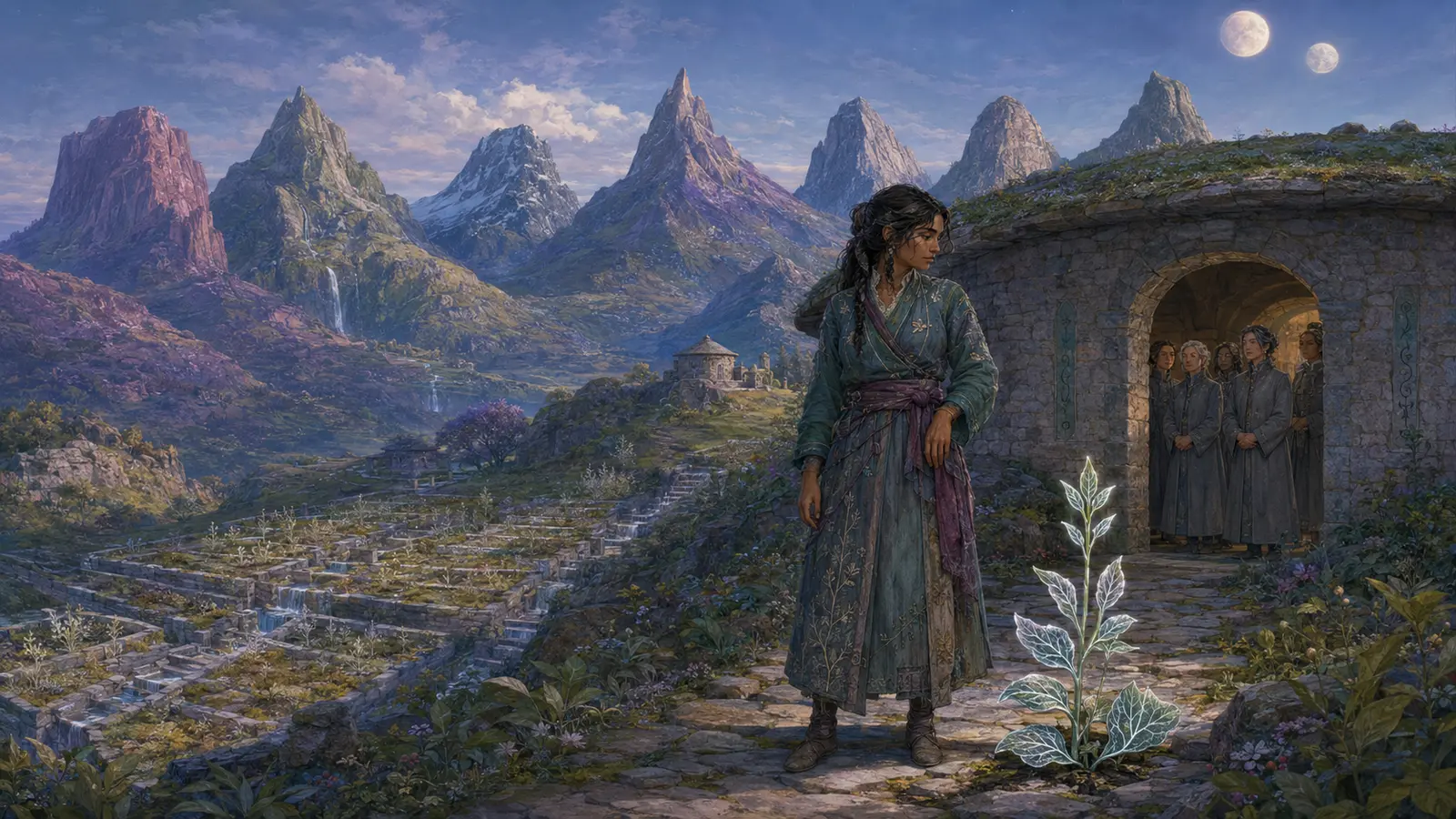
Near the place where she had once stood unable to enter, a silver-vein plant had pushed through the old edge of a terrace. It did not grow in a row. Its roots had found a narrow seam between two stones, where water gathered and the afternoon light arrived gently.
Its first leaf had opened.
Mera crouched beside it. She did not pick it, move it or straighten it.
She left it growing where it had found the conditions it needed.
And this is what the mountain communities remembered:
Caring words can comfort someone for a moment. They cannot make a harmful place safe. Help becomes real when something changes.