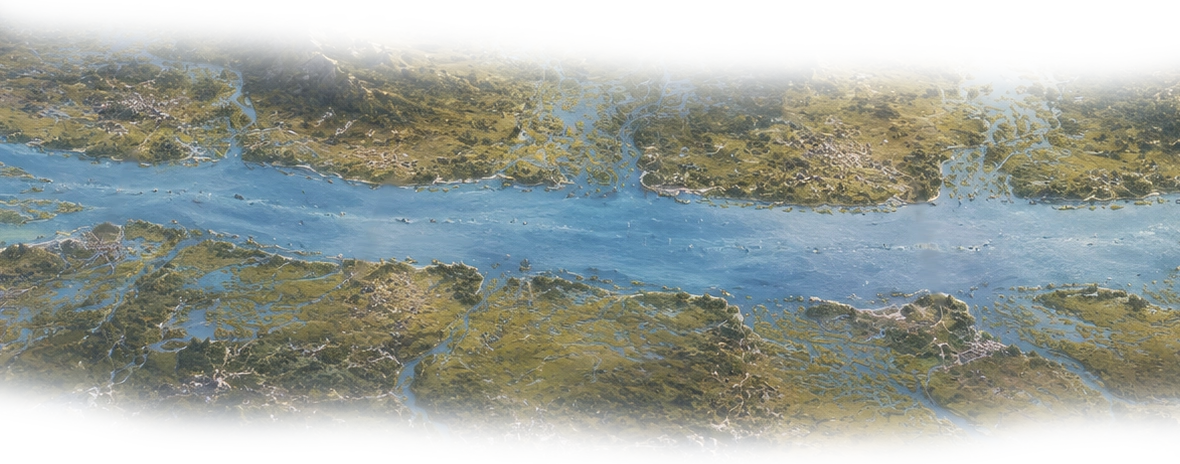
Vaelinya does not only count time by numbers. People read time from light, shadow, water, bells, seasons, and the two moons.
A village may know the day by the length of a shadow. A river crossing may depend on mist and water height. A longer journey may be planned by moon-turns, water-turns, and the shared calendar.
The calendar is shared, but time is lived locally.
Day reading
The day is read from light
Most people in Vaelinya do not begin by asking for a number. They ask what part of the day they are in.
A child might be told to come home by falling light. A gathering might begin after first light. A watcher may wait until high day, when shadows are shortest and paths are easiest to read.
first light
high day
falling light
lampkindle
moonrise
high moon
deep night
Shared signal
Bells carry the time
The bells are public signals. They do not decide the time by themselves.
A Timekeeper reads the signs first: light, shadow, water, weather, season, and sometimes the moons. When the right moment arrives, the bell carries that time across the settlement.
A bell is how one person’s reading becomes everyone’s shared moment.
Two moons
The moons keep longer turns
Vaelinya has two moons.
Aelun is the larger visible moon, used in ordinary counting, travel, planting, and common moon-turns. Saelith is smaller or farther, and belongs more to older reckonings: long promises, rare alignments, hidden places, and deep records.
People may plan by a bell, a day-part, a water-turn, or a moon-turn. The longer the plan, the more the moons matter.
Local count
Time is local, but not random
Time in Vaelinya is local, but it is not random.
Each place reads its own light, water, paths, and weather. But the moons, arcs, months, and water-turns give people a shared way to plan across distance.
A village bell may be local. A market day may be regional. A moon-turn belongs to everyone.
In Vaelinya, the great river is not only a place. It is one of the ways time becomes visible.
Water-turns
Water changes the count
Water is one of Vaelinya’s strongest clocks.
Because the Rim and the great river sit at the centre of Vaelinya’s life, water-time affects travel, food, danger, trade, bells, and stories.
Because Vaelinya has two moons, the water does not follow one simple tide. Aelun and Saelith pull at different rhythms, so river people watch many water-times in the same day and across the longer moon-turns.
When the two moons align, their pull can become dangerous. The river may rise hard, old channels may open, and sea creatures from the far water can be drawn inland through the great river.
Along the Rim and the broad river lands, people plan around mist, current, water height, and safe crossing times. A crossing may not be planned for a number on a clock. It may be planned for moon-slack, first lift, twin pull, or before the river begins to rise.
The year is not only warm or cold. It is also wet, loosening, rising, thinning, returning, and holding.
moon-slack
first lift
flood rise
twin pull
old-channel opening
low-water showing
cool mist return
Shared year
The calendar has four arcs
Vaelinya has a shared calendar of four arcs and twelve months.
The arcs are Holding, Loosening, Opening, and Returning. These are not just seasons in the Earth sense. They describe how the world holds, loosens, opens, and returns through water, light, cold, growth, mist, and river change.
Holding
Frosthold · White Edge · Deep Quiet
Loosening
First Run · Soft Bank · Floodwake
Opening
Reedrise · Long Light · Thin Water
Returning
Mistreturn · Dark Reed · Ash Frost
The same month may feel different in different places. A river settlement may watch flood signs. An upland path may still be held by frost. A reedland may count by mist and hidden channels.
◎
Time artefact
The Listening Clock gathers the signs
Some places keep more elaborate instruments. The Listening Clock gathers light, bell marks, water signs, seasons, and the two moons into one visible pattern.
It does not only show a time. It shows what the world is doing. Some Timekeepers say the oldest clocks also remember promises.