Lina of Vaelinya
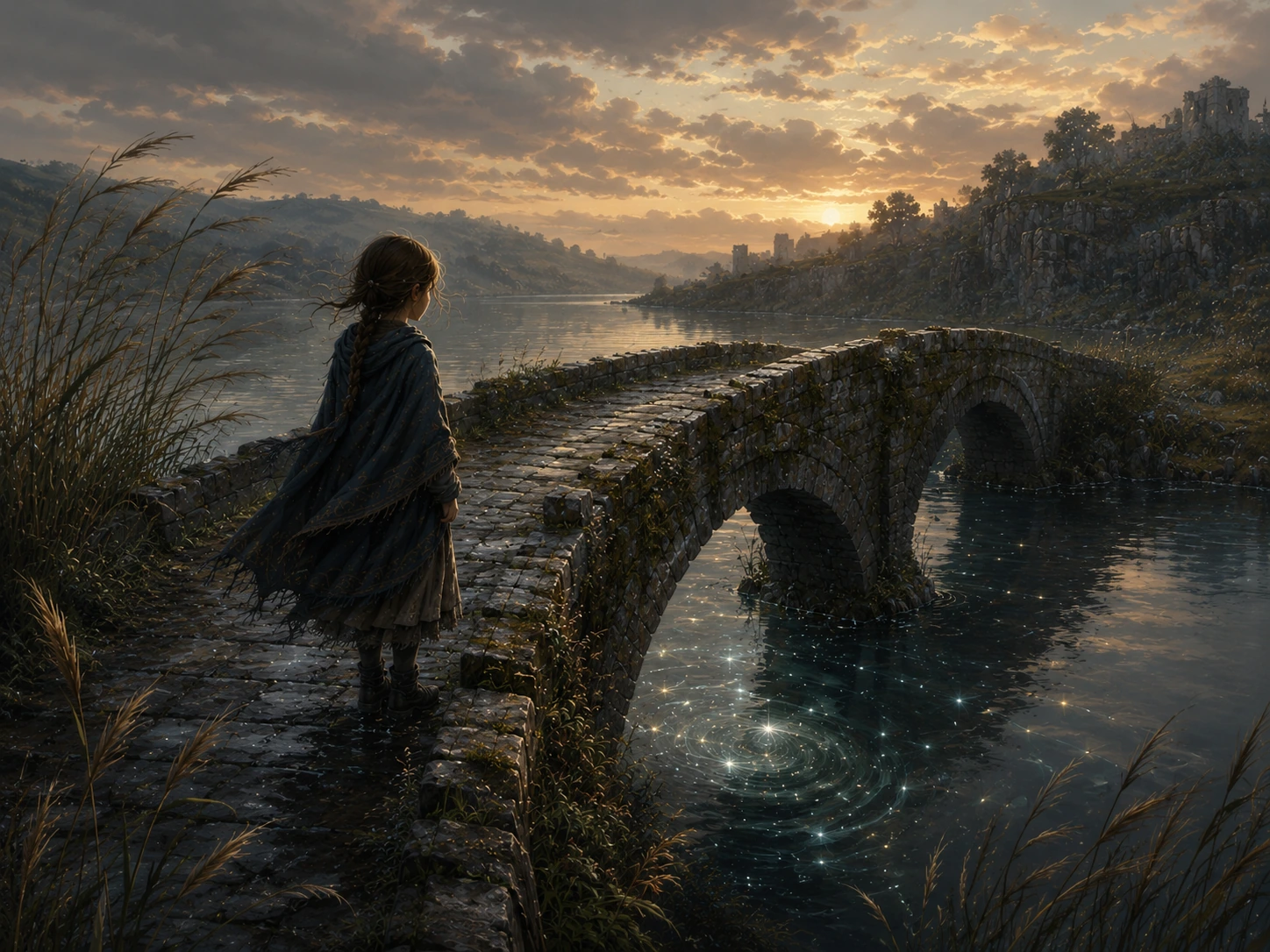
The Bridge That Sang Back
Lina — Story 1 of 8
Lina finds a bridge that was not there before, and learns that some crossings only appear when someone listens closely enough to sing back.
The Great Canyon cut through the morning like a dark blue question.
It had always been there, long before Lina was born, long before her mother was born, and long before the oldest people in the village began telling stories by the fire. It ran between two high shelves of stone, with silver mist turning slowly at the bottom. On clear days, Lina could see small pale shapes moving far below, as if fish were swimming through the cloud.
People crossed the canyon only by the old road, which wound for three days to the north before finding a safe narrow place. Everyone knew the rule. You kept back from the edge. You kept your hands near small children. You respected the wind, because canyon wind liked to change its mind.
Then, one dawn, a bridge appeared.
It stretched from one side of the canyon to the other, thin and bright as a line of moonlight laid across the air. It had no ropes, no posts, no stone feet, and no builders standing proudly beside it. The bridge simply waited above the mist, shining with soft colours that moved under its surface like fish under ice.
By breakfast, half the village had come to stare.
By midmorning, everyone had an opinion.
“It is unsafe,” said old Master Orrow, leaning on his stick.
“It is beautiful,” said Lina’s friend Tam, which was true but did not help much.
“It is a trap,” said a woman with flour still on her sleeves.
“It is a blessing,” said a man who always wanted strange things to be blessings once they happened far enough away from his own front door.
Lina stood behind her mother’s skirt and listened.
The adults spoke over one another. Their words crossed and tangled in the air. Safe. Dangerous. Holy. Foolish. Test. Warning. Gift. Trick.
The bridge said nothing.
At least, that was what everyone else thought.
Lina heard something.
It was very faint, almost hidden inside the morning wind. A thin clear note trembled beneath the talk, as if the bridge had a voice too small for shouting.
Lina took one step closer.
Her mother touched her shoulder. “Careful.”
“I am,” Lina said.
She was careful. That was one of the things people often missed about her. Lina did quiet things, so people sometimes thought she was drifting. Really, she was gathering details. She saw where the bridge-light brightened when the wind moved. She saw how the mist below rose towards it and then fell back. She saw a little trail of brightness run along the bridge when someone laughed too loudly.
Most of all, she heard the note.
It sounded lonely.
The village kept watch all day. Nobody crossed. A few people threw pebbles onto the bridge. The pebbles rolled halfway across, rang like tiny bells, and vanished into sparks. That made everyone step back and talk even more.
Lina stayed after the crowd thinned.
She sat on a flat stone near the edge, with her knees drawn up and her hands folded around them. Her mother stayed close enough to reach her, but gave her room to look.
The bridge gleamed.
The canyon breathed mist.
Lina hummed.
It was only a small sound, the sort of sound she made when she was thinking. Three notes, low and soft.
The bridge answered.
A thread of green light ran from the near end of the bridge to the middle and faded there. The sound that came back was almost the same as Lina’s hum, but clearer, as if the bridge had washed it in rainwater.
Lina’s breath caught.
She hummed again.
This time the bridge answered in blue.
Her mother heard it too. Lina knew because her mother’s hand tightened gently on her shoulder.
“Did you do that?” her mother asked.
“I think we both did,” Lina said.
The next morning, Lina came back with her wooden recorder.
It was a plain little thing, smooth from her fingers and marked near the mouthpiece where she had once dropped it on a stone step. She carried it carefully with both hands. Her mother walked beside her, quiet and watchful.
A few villagers had gathered again. Word had moved quickly, as word always did when something impossible happened within sight of ordinary houses.
Lina stood before the bridge.
The first plank of light brightened beneath her shadow.
She lifted the recorder and played one clear note.
The bridge answered.
The same note came back, fuller and warmer, and the first step of the bridge grew solid enough to see properly. It looked like glass, but softer. It looked like moonstone, but alive.
Lina put one foot on it.
The adults behind her made a sound together, half fear and half astonishment. Her mother’s hand moved, then stilled. Lina heard that too: the small hard sound of someone choosing trust while fear sat beside it.
The bridge held.
Lina played a second note.
The bridge answered.
She took a second step.
One note, one footstep.
That was how the crossing began.
Lina did not rush. The canyon was deep, and fear walked beside her, light and cold. She let it walk there. She had learned that fear behaved better when it was named and given a place, instead of shoved into a corner where it could kick the walls.
Below her, the silver mist turned slowly. Pale shapes moved inside it. One rose close enough for Lina to see a long fin of light, then sank back into cloud.
She played another note.
The bridge answered.
Step.
Note.
Answer.
Step.
The village grew smaller behind her. The far side came nearer, though it still looked like a painted place from a story: dark trees, white stones, a line of moss shining green under the bridge-light.
Halfway across, the wind changed.
It came up from the canyon in a sudden cool rush and took Lina’s next note away. The sound scattered into the mist. The bridge under her feet dimmed.
Lina stopped.
For a moment she could hear everything: the wind, the turning mist, the frightened breathing of the people behind her, and her own heart knocking in her chest.
She lifted the recorder again.
Her fingers knew the tune, but the bridge stayed dim.
The old notes had brought her this far. They would not carry her the rest of the way.
Lina looked across the canyon.
The far side waited.
The near side waited.
The bridge waited most of all.
So Lina lowered the recorder.
Her hands were shaking. She let them shake. Then she opened her mouth and sang.
At first, the song was hardly more than breath. It wavered in the wind and almost broke apart. Lina closed her eyes and listened until she found the bridge’s hidden note again, the tiny one she had heard beneath all the village talk.
She sang that note back.
The bridge answered.
Light spread under her feet, silver first, then green, then blue, then a warm colour like honey held up to the sun. The bridge did not copy her this time. It joined her.
Lina sang the next note.
The bridge sang beside her.
The canyon filled with music.
The mist below opened in slow rings. The pale fish-shapes rose, turning and flashing under the bridge as if they too had been waiting for the right sound. On the far side, moss began to glow along the ground, one small patch at first, then another, then a whole narrow path of green-gold light.
Lina walked.
She had never felt so small. She had never felt so clearly herself.
The last step shone before her.
She placed her foot on the far side.
The bridge rang once from end to end.
Behind her, the villagers gasped. Before her, the new path brightened between the dark trees. Small white flowers opened along it, each one shaped like a listening ear.
Lina turned back.
The bridge was still there, stretched across the canyon. Light moved through it in slow waves. It seemed pleased, though Lina could not have explained how a bridge could look pleased.
Then a sound came through the air.
It was not a word. It had no mouth, no letters, and no voice that belonged to a person. But Lina understood it.
Thank you.
She held the recorder against her heart.
“You’re welcome,” she whispered.
The bridge brightened once more.
Then it began to dissolve.
The colours rose from it like sparks from a winter fire. The glassy steps thinned. The shining line softened into mist. In a few breaths, the bridge was gone.
But the path on the far side remained.
So did the flowers.
So did the feeling in Lina’s chest, as if a door had opened there and would remember being open.
The old road still wound three days to the north. The canyon still ran deep and dangerous through the land. The wind still changed its mind. But now, on the far side, where nobody from the village had stood for longer than anyone could remember, a green-gold path waited among the trees.
Lina crossed back by the old northern road with her mother and three very worried adults who kept looking at her as though she might vanish into song if they blinked.
By evening, Lina was home.
Her boots were muddy. Her fingers smelled of wood and wind. Her throat felt warm from singing.
Her mother helped her wash, then tucked her under the woven blanket with the little silver stars stitched along its edge. A star-lantern turned slowly above the bed, sending soft points of light across the ceiling beams.
Lina’s recorder lay on the small table beside her.
For a while, neither of them spoke.
Then her mother picked a tiny shining bead from the cuff of Lina’s sleeve. It was no bigger than a raindrop. It glowed silver, then green, then blue, then honey-gold.
Bridge-light.
Her mother held it carefully in her palm.
“Well,” she said quietly. “You brought a little of it home.”
Lina smiled, sleepy now.
“I think it brought a little of me with it too.”
Her mother looked at her for a long moment, the way people look when they are trying to understand something precious without closing their hand too tightly around it.
Then the recorder gave one small note.
Just one.
Clear and high and gentle.
The bridge had gone. The listening had stayed.