Lina of Vaelinya
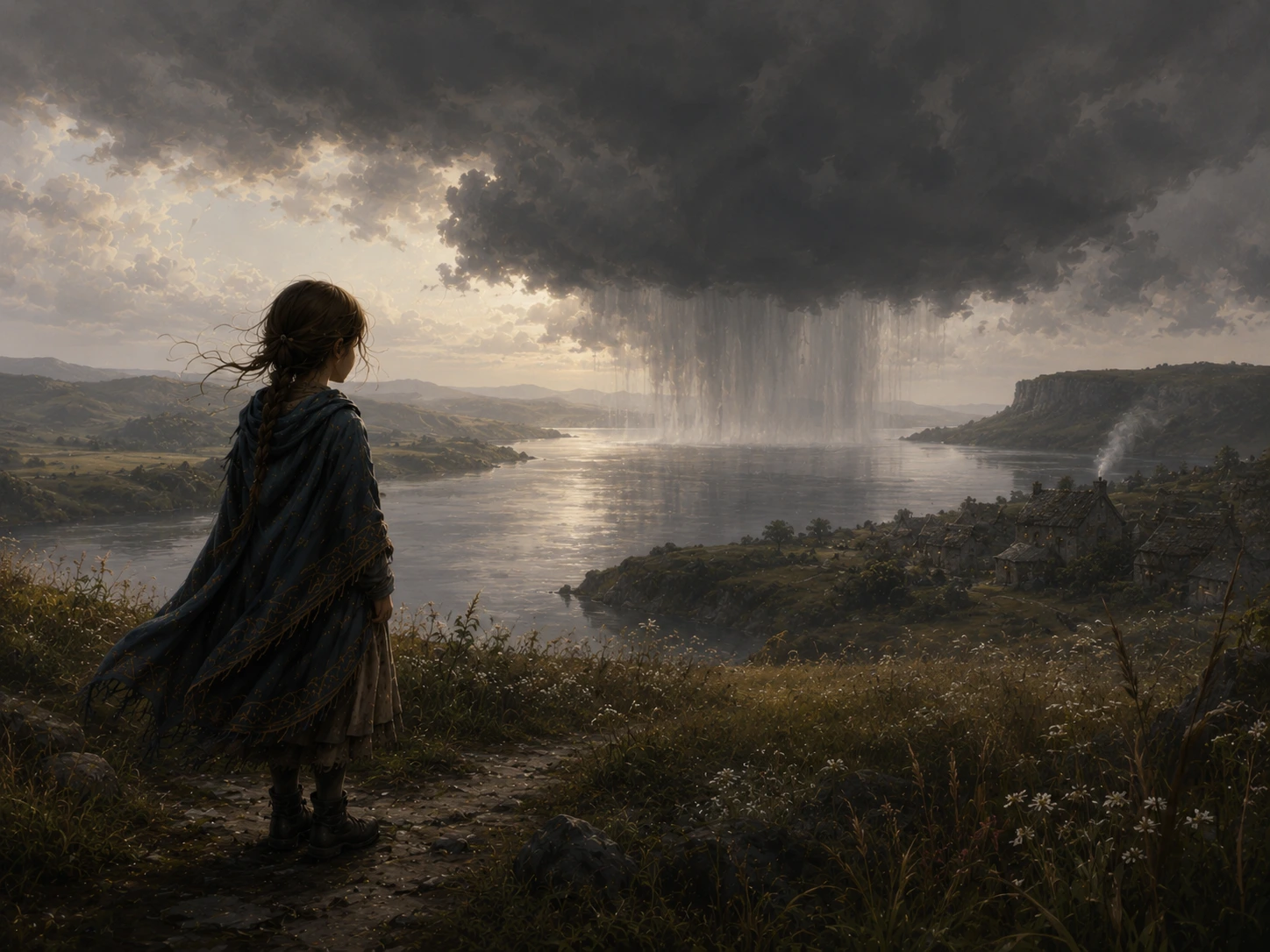
The Cloud That Cries
Lina — Story 2 of 8
A small cloud has sunk too low to the ground, heavy with warm rain. Lina stays beneath it and learns that some weather needs a witness before it can rise.
Three mornings after the bridge sang back, the meadow began to cry.
At first, nobody called it that. People said the grass was wet, or the mist had come down strangely, or the rain had forgotten where the sky was. They said practical things because practical things were easier to carry.
But Lina knew crying when she heard it.
The meadow lay just beyond the first bend of the canyon path, where the grass grew long and soft and the little white listening-flowers opened whenever the wind came from the east. Since the bridge had appeared and vanished, Lina had walked that way often. She liked to stand where she could see the far side of the canyon, with its new green-gold path shining between the trees.
That morning, she saw the cloud before she saw the meadow.
It hung so low that its grey-blue edges brushed the grass.
It was smaller than an ordinary cloud, no bigger than the roof of a cottage, and it sagged in the middle as if something heavy had been set inside it. Rain fell from it in thin warm threads. The drops did not patter like normal rain. They made a soft, uneven sound, almost like breathing after tears.
Drip.
Pause.
Drip-drip.
Pause.
Lina stood at the edge of the meadow and listened.
The cloud cried on.
A woman with a basket on her arm hurried past, lifting her skirt above the wet grass.
“Best keep away from that,” she said. “It soaks everything.”
A boy tried to run through the meadow and came out with his hair plastered to his forehead and his sleeves dripping. He laughed at first, because boys sometimes laughed when they wanted people to think they had meant to do something foolish. Then a warm drop slid down his cheek, and his face changed.
“It feels sad,” he said, very quietly.
His older brother pulled him away. “It’s only rain.”
But it was not only rain.
Lina could hear the difference.
Normal rain had many voices. Roof rain tapped. Leaf rain whispered. River rain joined everything together and made the world smell green. This rain had one voice, small and tired, repeating itself because nobody had answered.
Lina stepped into the meadow.
The first drops touched her hair. They were warm against her forehead. Not hot. Not uncomfortable. Warm in the way a hand could be warm when someone held it for a long time.
Her boots sank a little into the wet ground.
The cloud lowered.
People on the path noticed.
“Lina,” called her mother from near the gate. She did not shout. Lina’s mother had learned that shouting at Lina across distance often made the whole world become noise. “Are you all right?”
“I think so,” Lina called back.
“Do you want me near?”
Lina looked up at the little cloud. Its underside trembled. Another line of rain fell straight onto the grass in front of her.
“Not yet,” Lina said. “But stay where I can see you.”
Her mother stayed by the gate.
That was one of the things Lina loved about her. She knew how to be close without standing in the middle of everything.
Lina walked until she was underneath the cloud.
The rain fell all around her.
It ran down her hair and over her cheeks. It soaked the shoulders of her blue dress and darkened the cream wrap her mother had made for cool mornings. It gathered on her eyelashes until the meadow shivered into little broken lights.
The cloud made a sound.
It was almost a word.
Almost.
Lina tilted her head.
“Hello,” she said.
The cloud squeezed itself smaller.
Rain came faster.
Lina sat down in the grass.
Mud pressed cold through the cloth of her dress. The rain was warm. The two feelings met and made a strange middle feeling, like sitting between sorrow and soup. Lina nearly laughed at that thought, but the cloud gave such a wet, tired shudder that she swallowed the laugh and kept it safe for later.
“I won’t hurry you,” she said.
The cloud rained.
A little beetle climbed onto a blade of grass beside Lina’s knee and cleaned its face with great seriousness. A line of ants had taken shelter under a curled leaf. The listening-flowers had closed their white petals, but not tightly. They seemed to be waiting.
Lina put her hands on her knees and listened properly.
The rain had a rhythm.
Drip.
Pause.
Drip-drip.
Pause.
Drip.
It sounded like someone trying to speak while remembering how.
Lina tapped the rhythm gently on her knee.
The cloud stopped raining for one breath.
Then it answered.
Drip.
Pause.
Drip-drip.
Pause.
Lina tapped again.
This time she added one soft hum, low in her throat.
The cloud’s edges quivered. The rain changed. It still fell, but the drops came slower, rounder, each one bright at the edge.
Something moved inside the cloud.
Not a face. Not a mouth. More like a hollow where a face might have been if clouds were made for faces, which Lina suspected they were not.
A sound came out of it.
“Loooooost.”
The word stretched thin in the rain.
Lina did not jump. She wanted to, a little, but she had learned from the bridge that strange things often needed one calm moment before they became less strange.
“Lost?” she asked.
The cloud sagged so low that a grey wisp brushed her shoulder.
“Too heavy,” it whispered.
The rain warmed.
Lina thought of the bridge-light bead still resting in a small shell on the shelf beside her bed. She thought of the canyon, and the way the far side had waited until she sang back. She had crossed a deep place with music. Now she was sitting under a low place with rain.
“What are you heavy with?” she asked.
The cloud gave a small broken rumble.
For a moment, Lina saw pictures inside the rain.
A hilltop with no one on it.
A flock of birds flying below the cloud instead of through it.
A song rising from a village and stopping before it reached the sky.
A child’s laugh forgotten in a field after everyone had gone home.
Then the pictures broke into drops and fell onto Lina’s hands.
She understood only a little.
That was all right. Understanding everything was not the price of staying.
“I can sit with you,” Lina said.
The cloud trembled again.
“No fixing?” it whispered.
Lina looked down at her muddy boots. Her toes were beginning to feel damp. Her hair had stuck itself to her face in several unhelpful strands. A drop ran into her ear, which was rude of it.
“No fixing,” she said. “Only sitting.”
The cloud made a sound that might have been relief, if clouds could be relieved.
Lina sat.
The village path grew quieter. People stopped calling advice. Her mother remained by the gate, a steady shape in the grey morning. Once, a man came near with a broom, as if he might sweep the cloud away. Lina’s mother looked at him. He looked at the broom. Then he went somewhere else.
The rain kept falling.
Lina did not talk much. When the cloud whispered, she listened. When it only rained, she let it rain. When her own legs grew cold, she shifted a little and stayed.
After a while, she began to hum.
It was not the bridge song. The bridge song had steps in it. This song had a bowl shape. It held the rain without trying to pour it away.
The cloud listened.
The listening-flowers opened one petal each.
Lina hummed again.
The cloud’s middle lifted by the smallest amount.
Not enough for anyone on the road to notice. Enough for Lina to see the grass straighten beneath it.
“That’s it,” Lina said softly. “You don’t have to be light all at once.”
The cloud rained a little harder at that, but the rain sounded different. Less stuck. The drops fell into the meadow and ran together in tiny silver lines. The lines joined, curled, and slipped between the roots of the grass.
The ground drank.
The flowers opened another petal.
Lina looked at them and understood something she did not need to say aloud.
Some crying went into the earth.
Some crying became growth.
Some crying simply had to be cried.
The cloud rose another hand’s width.
A pale line of gold appeared along one edge.
The people on the path began murmuring again, but more quietly now. Nobody threw pebbles. Nobody fetched a broom. A small child came to the fence and watched with both hands around the bars.
“Is it better?” the child asked.
Lina considered this.
The cloud still looked grey. Rain still fell from it. Its middle was no longer sagging quite so much, but it had not turned white and cheerful. It had not become a puffball in a picture. It was still the same cloud.
“It’s moving,” Lina said.
The child nodded, as if that answer made sense.
The cloud heard it too.
“Moving,” it whispered.
“Yes,” Lina said. “You can be sad and moving.”
The cloud’s rain slowed.
One drop landed on Lina’s palm and stayed there, round and warm. Inside it, she saw a tiny upside-down picture of the meadow: herself sitting in the grass, the low cloud above her, her mother by the gate, the child at the fence, the white flowers opening one petal at a time.
The drop trembled.
Then it sank into her skin like warmth.
Lina hummed the bowl-shaped song once more.
The cloud rose.
This time everyone saw.
It lifted slowly, trailing threads of rain like long silver hair. The grass beneath it brightened. The listening-flowers opened fully, and among them Lina saw new flowers she had never seen before: small blue-grey cups, each holding one clear drop at its centre.
The cloud rose above Lina’s head.
Then above the fence.
Then above the cottage roofs.
It did not vanish. It did not become bright all over. It stayed grey at the middle and blue at the edges, with a gold line where the light had touched it. It drifted toward the canyon, higher now, moving with the other clouds instead of sinking alone into the field.
Before it went, one last drop fell.
It landed on Lina’s sleeve and shone there.
Not bridge-light this time.
Rain-memory.
The cloud whispered once more.
“Seen.”
Lina pressed her wet hand to her heart.
“Yes,” she said. “Seen.”
By then she was very damp.
Her mother came across the meadow with a dry shawl and wrapped it around Lina’s shoulders. She did not fuss too much, though Lina could feel the fuss waiting inside her like a kettle almost ready to sing.
“You’re soaked,” her mother said.
“Yes,” Lina said.
“Cold?”
“A bit.”
“Sorry?”
Lina looked up at the sky. The little cloud had reached the canyon path. It moved slowly with the others, still itself, but no longer alone.
“No,” Lina said. “Just wet.”
Her mother followed her gaze.
Above the meadow, the blue-grey flowers held their drops in silence.
“What are those?” her mother asked.
“I don’t know yet,” Lina said.
That felt like a good answer. Vaelinya was full of things she did not know yet.
She touched one flower gently. The drop in its centre warmed under her finger, and for one moment Lina heard the cloud’s rain-rhythm again.
Drip.
Pause.
Drip-drip.
Pause.
But now there was space around it. Sky around it. Breath around it.
Lina smiled.
The cloud had not stopped being a cloud that cried.
It had remembered how to rise.