Lina of Vaelinya
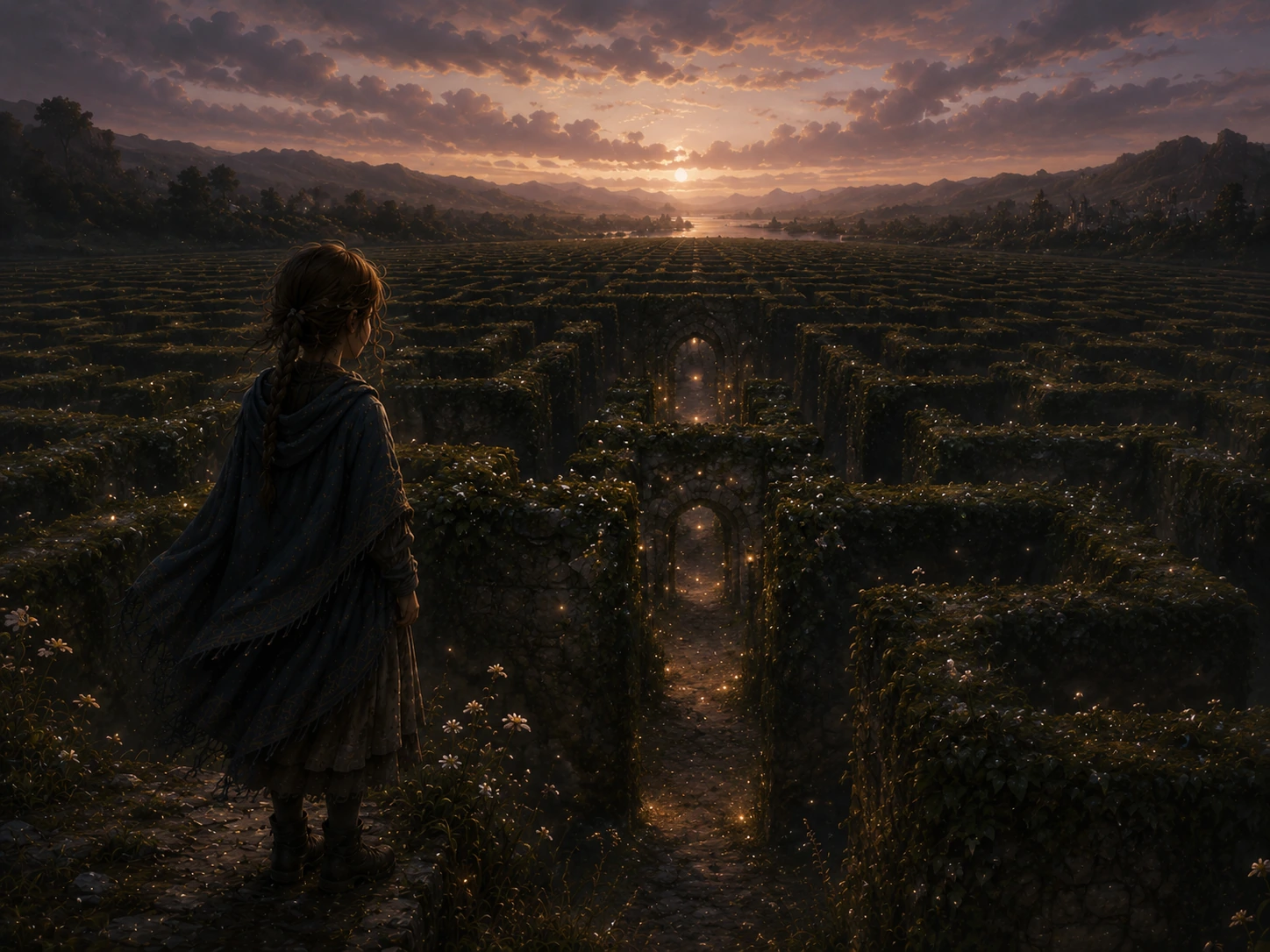
The Maze That Remembers
Lina — Story 3 of 8
A living maze leads Lina back to a part of herself she once left behind.
The maze was not there on Monday.
On Monday, the field beyond the rain meadow held ordinary things: grass, stones, a leaning fence, three stubborn thistles, and one brown goat who believed the world had been made mainly for chewing.
On Tuesday, the field had walls.
They stood where no walls had stood before, low at first, then taller as Lina came nearer. Silver stones rose out of the earth in careful rows. Dark green vines curled over them, stitching one wall to the next. Leaves hung thickly from the vines, each leaf shining faintly underneath, as though it had swallowed a small piece of moon.
The goat stood outside the entrance, chewing the last free thistle and looking offended.
Lina stopped beside it.
The goat chewed at her.
Lina looked at the maze.
The maze looked back.
Not with eyes. It had none. But Lina had learned by now that many things without eyes still knew how to notice you.
A narrow opening waited between two silver-stone walls. Inside, the path bent left almost at once. Beyond that bend, Lina could see green light and shadow, and hear a small sound like pages being turned very slowly.
She did not step in immediately.
That was another thing people often missed about Lina. When she did brave things, they sometimes thought she had stopped being afraid. She had not. Fear still came. It arrived with cold fingers and sensible questions.
What if the maze closes?
What if the path changes?
What if this is not for you?
Lina took a breath.
The goat nudged her elbow with its nose.
“That is not advice,” Lina told it.
The goat blinked.
From inside the maze came the sound again.
Page.
Pause.
Page.
Lina thought of the bridge, which had sung back.
She thought of the cloud, which had cried until it could rise.
This sound was different. It did not ask her to cross. It did not ask her to stay. It sounded as if something were being kept.
Lina put one hand on the nearest wall.
The stone was warm on one side and cool on the other.
A leaf unfolded beside her fingers.
On its underside, a tiny picture shimmered: Lina at six years old, crouched under a table while adults talked above her. Her hands were clamped over her ears. Her face was fierce with the effort of making no sound.
The picture vanished.
Lina pulled her hand back.
The goat stopped chewing.
The maze waited.
“Oh,” Lina said.
Then she stepped inside.
The path closed behind her with a soft green rustle.
Lina turned quickly. The entrance was still there, but smaller, as if the maze had taken a breath and drawn itself closer. She could still see the goat through the gap. It was now eating a vine it almost certainly should not have been eating.
“I can still get out,” Lina said.
The maze did not disagree.
That helped a little.
She walked on.
The path was narrow, but not cruel. The walls came to Lina’s shoulder at first, then to her head, then above it. Leaves brushed her hair. Every few steps, one opened to show a little memory.
Lina saw her old blue cup with the chip in the rim.
She saw the day she had hidden behind the washhouse because too many people had come to visit.
She saw a row of stones she had once arranged by colour, only for someone to sweep them back into a pile because the path needed clearing.
She saw herself asking a question at supper, then another, then another, until an uncle laughed and said, “That child has a head full of bees.”
The memory-leaf trembled.
Lina remembered how everyone had laughed.
She remembered laughing too, because laughing with people was safer than being the thing they laughed at.
A vine slid across the path in front of her.
Not fast. Not like a trap. More like a line being drawn.
Lina stopped.
“I was only little,” she said.
The vine stayed there.
Lina tried another path.
The maze allowed it.
For a while, she tried to solve it sensibly. She kept one hand on the left wall, because someone had once told her that was how to get through a maze. She counted turns. She looked for moss. She made marks in the mud with a stick.
The maze politely ignored all of this.
Paths moved after she passed them. A turn she had counted as left became a straight green corridor when she looked back. Her stick marks filled with tiny flowers. The moss grew everywhere, which was beautiful but unhelpful.
After the seventh wrong turn, Lina sat down on a low stone and folded her arms.
“I know what you’re doing,” she said.
The maze rustled.
“You’re not a puzzle.”
A leaf opened near her knee.
This time the memory was only a sound.
A small Lina voice, high and urgent, saying, “But why does the moon follow us if it is so far away?”
Then an older voice, tired and sharp: “Enough questions, Lina.”
The leaf closed.
Lina’s hands tightened in her lap.
“I did ask too many,” she said.
The walls leaned closer, just a little.
Not threatening.
Listening.
Lina looked at the mud on her boots. She wanted to say the sensible thing. She wanted to say: I know they were tired. I know I was difficult. I know children must learn when to stop.
All of that was partly true.
None of it opened the path.
A small sound came from deeper in the maze.
It was not page-turning.
It was a sniff.
Lina lifted her head.
The path ahead had changed. The left wall had loosened into an arch of vines. Beyond it, green-gold light pooled on the ground.
Lina stood.
The archway led to the centre of the maze.
It was a round space, no wider than a cottage room, with silver stones set in a circle and leaves hanging down like a curtain. In the middle stood a low stone seat.
Someone was sitting on it.
A child.
A smaller Lina.
She looked about five years old. Her dark hair had been tied badly and was escaping in wisps around her face. Her blue dress was muddy at the hem. She held a handful of bright stones, red and yellow and green, sorted carefully across her lap.
She did not look up.
Lina stood at the edge of the circle.
Her throat felt tight.
The smaller child moved one stone from one row to another.
“You found me,” the little girl said.
Her voice was Lina’s voice and not Lina’s voice. It was thinner, quicker, full of the sharp bright edges Lina had spent years smoothing away.
“I think the maze found you,” Lina said.
The smaller Lina shook her head. “No. The maze kept me.”
“Why?”
“Because you didn’t.”
The words were plain. They did not shout. That made them worse.
Lina stepped into the circle.
The leaves whispered overhead.
“I didn’t know I left you,” she said.
The smaller Lina looked up then.
Her eyes were wet, but angry too. Lina remembered that anger. It had lived in her like a little red bird beating its wings against a closed box.
“You put me away,” the smaller Lina said. “You learned to be quieter. You learned to stop asking. You learned to smile when they said your head was full of bees.”
Lina swallowed.
“I was trying to be good.”
“I was good.”
The maze went very still.
Lina looked at the stones in the child’s lap. They were arranged in rows by colour, then by size, then by some secret rule Lina recognised at once and could not have explained to anyone else.
“You were,” Lina said.
The smaller Lina stared at her suspiciously.
Lina sat on the ground, not too close.
“I forgot that,” she said. “I thought good meant easier for everyone.”
The child looked down at her stones.
“Was I too much?”
There it was.
The question Lina had not known she still carried.
It moved through the centre of the maze like a cold wind. Leaves curled inward. The silver stones dimmed. For a moment, Lina was back under the table with her hands over her ears, back behind the washhouse, back laughing at the joke before anyone could see it hurt.
She wanted to answer quickly.
No. Of course not. Never.
But quick answers could be another kind of hiding.
So Lina listened first.
She listened to the child’s breathing.
She listened to the leaves.
She listened to the old question.
Then she said, “You were a lot.”
The smaller Lina flinched.
“And alive,” Lina said. “And bright. And full of questions. And sometimes hard for tired people. And still not wrong.”
The maze gave one soft rustle.
The smaller Lina’s fingers loosened around the stones.
“I made patterns,” she whispered.
“I know.”
“They said I was wasting time.”
“You were making sense.”
“I cried when they moved things.”
“I know.”
“They laughed when I asked about the moon.”
“They should have answered better.”
The child looked at her then with such fierce hope that Lina’s chest hurt.
“Can I come out?” she asked.
Lina looked around the centre of the maze.
There was no doorway now. Only walls, leaves, stones, memories.
“I don’t know how,” Lina said.
The smaller Lina’s mouth trembled.
“But I won’t go without you.”
That was the true thing.
As soon as Lina said it, the stone seat warmed. A leaf fell from the wall and landed between them.
It was dark green, with a silver stem and veins of pale gold. On its surface were two sets of footprints.
One set was Lina’s, the size her boots made now.
The other set was smaller.
Both sets led toward the edge of the leaf and vanished together.
The little girl touched it.
“That is us,” she said.
“Yes.”
“You have bigger boots.”
“Yes.”
“Mine were better for puddles.”
“They were.”
For the first time, the smaller Lina almost smiled.
Lina held out her hand.
The smaller Lina hesitated. Then she gathered her coloured stones into the pocket of her muddy dress and took Lina’s hand.
Her fingers were warm.
The maze opened.
It did not open all at once. It did not throw down its walls or turn into a straight road. It loosened. One vine shifted. One wall leaned aside. One narrow path appeared where leaves had been.
Lina and the smaller Lina walked together.
At first, the smaller child walked beside her as solidly as anyone. Lina could feel every tug of her hand, every skip over a puddle, every pause when a leaf showed a memory.
They passed the table memory.
The smaller Lina squeezed Lina’s hand.
They passed the washhouse memory.
Lina squeezed back.
They passed the head-full-of-bees memory.
This time, the little Lina stopped.
In the leaf-picture, everyone laughed again.
The smaller Lina lifted her chin and said, very clearly, “Bees know where flowers are.”
The leaf brightened.
Lina laughed.
Not the old safe laugh.
A real one.
The wall beside them shifted open.
As they walked, the smaller Lina grew lighter. Not less real. More like she was becoming something Lina could carry without using hands. Her fingers softened into warmth. Her outline became green-gold at the edges. By the time they saw the entrance, she was a small bright weight inside Lina’s chest, just under the place where fear usually knocked.
Lina did not feel suddenly whole.
That would have been too easy.
She felt damp-eyed, tired, and more crowded inside herself than before.
But it was a good crowded.
The maze entrance widened.
Outside, the goat was still there.
It had eaten several things it should not have eaten and was looking deeply satisfied with its choices.
Lina stepped out.
Behind her, the maze rustled once.
She turned.
The silver-stone walls were lower now. The vines had drawn back from the path. The leaves no longer showed memories unless Lina looked at them with full attention. The maze did not look smaller exactly, but it looked less like a place that needed to keep something hidden.
Lina opened her hand.
The memory-leaf lay on her palm.
Two sets of footprints crossed it: one large, one small, walking out together.
Her mother was waiting by the fence, as she often seemed to be waiting exactly where waiting was needed.
“You were a long time,” she said.
“Yes,” Lina said.
“Did you get lost?”
Lina looked back at the maze.
“No,” she said. “Not exactly.”
Her mother waited.
Lina could have explained. She could have said something about memories, hidden children, questions, bees, and the strange kindness of a maze that would not let you escape the wrong way.
Instead, she held out the leaf.
Her mother took it carefully.
The two sets of footprints glowed.
For a moment, her mother’s face changed. It became softer and sadder and prouder all at once.
“Oh, Lina,” she said.
Lina leaned against her.
“I think I left someone behind,” she said.
Her mother put an arm around her shoulders.
“And now?”
Lina looked at the leaf again.
The small footprints had not disappeared. They had not been swallowed by the larger ones. They walked beside them, clear and bright.
“Now she knows the way out,” Lina said.
The wind moved through the maze.
Every leaf turned once, silver side up, then green again.
Lina heard the page-turning sound one last time.
Page.
Pause.
Page.
But now it sounded less like something being kept shut.
It sounded like a book opening.